


Among the thousand names of Lord Shiva, few capture his nature as beautifully as Ashutosh. The name is not merely a title; it describes Shiva’s compassionate nature and his willingness to respond to the sincere devotion of his devotees. Several stories from Hindu tradition illustrate why he is known by this name. To understand this name better, it is helpful to first understand who is Shiva ? and his place in Hindu tradition. Understanding this name opens a window into how Shiva is imagined differently from many other deities across world mythology, and why he remains one of the most approachable gods in Hindu tradition.
What makes this name particularly interesting is how consistently it appears across different regions, languages, and devotional communities within Hinduism. Whether in a small village temple or a major pilgrimage site, the belief that Shiva responds quickly to sincere devotion remains largely unchanged, suggesting that this idea is not a later addition to his worship but something woven deeply into how devotees have understood him for centuries. This consistency is part of why exploring the meaning of Ashutosh offers more than just a definition. It offers insight into the emotional relationship millions of people feel they share with this particular form of the divine.
Breaking Down the Sanskrit Roots Behind Ashutosh

The word Ashutosh comes from two Sanskrit roots. Ashu means quick or swift, and Tosh comes from Tosha, meaning satisfaction or contentment. Put together, Ashutosh translates roughly to the one who is quickly satisfied, or the one who is easily pleased, a meaning that has shaped how devotees approach him in worship for centuries. In Hindu tradition, this name is used specifically to highlight a quality that separates Shiva from many other gods. According to popular belief and several Puranic stories, Shiva does not demand grand rituals, expensive offerings, or years of penance before responding to a devotee. Even a small act of sincere devotion, such as offering a handful of water, a bael leaf, or simply chanting his name with a pure heart, is said to be enough to move him.
This is different from some other deities in Hindu scriptures, who according to various stories are described as testing devotees over long periods before granting boons. Shiva, in contrast, is often shown responding almost immediately once he senses genuine faith, a trait that has made the name Ashutosh nearly synonymous with his approachability. This contrast does not suggest that other deities are less compassionate, only that Hindu tradition has chosen to highlight speed and simplicity as the defining quality of Shiva’s particular relationship with his devotees, setting him apart in the way he is remembered and worshipped across the subcontinent.
Where Ashutosh Fits Among Shiva’s Many Other Names

Ashutosh is one among many epithets of Shiva, such as Mahadev, Bholenath, Neelkanth, and Rudra. Each name reflects a different aspect of his personality or a different episode from mythology. While Neelkanth refers to the blue throat he received after consuming poison during the churning of the cosmic ocean, and Rudra points to his fierce, untamed side capable of destruction, Ashutosh speaks to something gentler, his generosity and warmth toward those who approach him with an open heart. You can also explore why Lord Shiva wears a snake around his neck and what this powerful symbol represents in Hindu tradition. Understanding how these names relate to one another helps explain why Hindu tradition rarely describes Shiva through a single fixed personality, choosing instead to layer multiple, sometimes contradictory, qualities into the same figure.
Many scholars believe this combination of contrasting qualities, fierce yet forgiving, ascetic yet accessible, is part of what makes Shiva such an enduring figure in Hindu tradition. He is not a distant, unreachable god confined to grand temples and elaborate rites. He is imagined as one who lives among cremation grounds and mountains, wandering far from comfort and convention, yet turns toward anyone who calls out to him sincerely, regardless of their status or the scale of their offering. This blending of extremes, a god capable of great destruction who is also quick to bless the humblest devotee, is part of what keeps Shiva’s character feeling both awe inspiring and deeply personal at the same time.
The Devotion of Ravana and the Speed of Shiva’s Grace
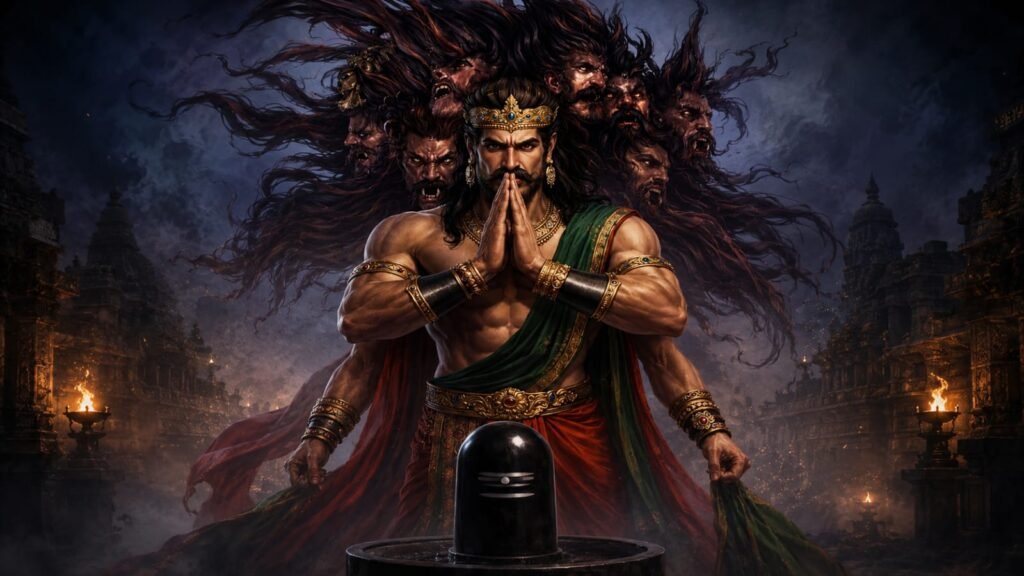
Hindu tradition preserves several stories, mostly found in the Puranas, that illustrate this quality of Shiva. These stories are not presented as historical events but as devotional teachings meant to show the nature of faith and grace, and each one approaches the theme from a slightly different angle, whether through a powerful king, a misguided demon, or a devoted young sage. According to the Shiva Purana and various regional retellings, Ravana, the king later associated with the Ramayana, was known as a devoted worshipper of Shiva long before the events that made him famous in that epic.
Ancient texts describe how Ravana’s penance and hymns, particularly the Shiva Tandava Stotram, are said to have pleased Shiva quickly, leading him to grant boons of great power. This interpretation varies across regional traditions, but the underlying theme remains consistent. Sincere devotion to Shiva is believed to bring swift results, regardless of the devotee’s later actions or moral standing, a detail that has sparked ongoing discussion among scholars about how Hindu tradition separates the sincerity of worship from the eventual conduct of the worshipper, treating devotion itself as something Shiva responds to independent of what may come afterward.
What makes Ravana’s story particularly striking within this context is the contrast it creates between his devotion and his later actions in the Ramayana. Hindu tradition does not use this contradiction to undermine the sincerity of his early worship, but rather to separate two distinct ideas, the purity of a devotional act and the moral choices a person makes later in life. This distinction is often highlighted in devotional teaching as a reminder that Shiva’s swift grace responds to the honesty of the moment in which it is offered, not as a permanent verdict on the character of the person offering it.
The Cautionary Tale of Bhasmasura’s Swift Boon
Another well known Puranic tale describes Bhasmasura, a demon who performed intense penance to please Shiva. According to this story, Shiva granted him a boon almost immediately once satisfied with his devotion, without pausing to weigh how the power might later be used. This part of the story is often highlighted precisely because it shows the Ashutosh trait taken to its fullest extent, a god so easily moved by sincere effort that he does not hesitate before rewarding it.
The boon Bhasmasura received, according to the Puranas, eventually led to a complicated and dangerous situation that required Lord Vishnu’s intervention to resolve, since the demon attempted to misuse the very power Shiva had granted him. This story is often used to explain both sides of the Ashutosh nature. Shiva grants boons readily, but the outcome depends entirely on the intent and wisdom of the one asking, a nuance that keeps this trait from being read as reckless generosity and instead frames it as trust placed in the devotee’s own judgment, for better or worse.
How Markandeya’s Simple Faith Overcame Death Itself
In the tale of the young sage Markandeya, ancient texts describe how his unwavering devotion to Shiva, expressed through simple worship rather than elaborate ceremony, moved Shiva enough to intervene against Yama, the god of death, and grant him a boon of everlasting life. Markandeya’s story is often told differently from the accounts of Ravana or Bhasmasura, since he sought no power or conquest, only the continuation of his devotion, which many scholars believe is part of why his story is remembered with particular warmth in devotional retellings.
This story is frequently cited as an example of how Shiva values sincerity over ritual complexity, showing that even in the face of death, a quiet and consistent devotion can be enough to draw his protection. Unlike the more dramatic accounts involving kings and demons, Markandeya’s tale reinforces the idea that Ashutosh applies just as much to ordinary devotees living simple, humble lives as it does to figures of great power or ambition.
Why This Quality Continues to Shape Everyday Worship
The idea of Shiva as Ashutosh has shaped how millions of devotees approach worship even today. In Hindu tradition, this belief encourages a devotional style that is simple, personal, and accessible rather than dependent on wealth or elaborate ceremony. It removes the barrier of needing costly rituals to seek blessings, and it encourages sincerity and inner devotion over outward display, making Shiva relatable to farmers, ascetics, and kings alike, according to various Puranic narratives that describe devotees from every walk of life receiving his attention in the same way.
During the month of Shravan, for example, many devotees observe fasts and offer plain water, milk, or bael leaves at Shiva temples, following the belief that these simple acts, done with devotion, are enough to please him. Many scholars believe this practice reflects a broader philosophical idea within Shaiva tradition, that the divine is not distant or transactional but responsive to genuine intention, a view that differs somewhat from more ritual heavy traditions found in other parts of Hindu practice, though both approaches are respected within the wider religious framework and are not considered to be in conflict with one another.
How Ashutosh Compares to Other Divine Traits in Hindu Belief
To understand why this particular name stands out, it helps to consider it alongside other well known descriptions of deities in Hindu tradition. Vishnu is often praised through the name Dayanidhi, meaning ocean of compassion, which speaks to his protective and preserving nature across the universe. Parvati is honored as Annapurna, the giver of food, emphasizing nourishment and sustenance for all beings. Ganesha carries the title Vighnaharta, remover of obstacles, tied closely to his role in clearing paths for devotees before any major undertaking, while Shiva himself is also known as Trinetra, the three eyed one, a name rooted in insight and the destruction of ignorance.
Set against these, Ashutosh stands out for its specific emphasis on speed and simplicity of divine response, a trait Hindu tradition attaches almost exclusively to Shiva. Where other epithets describe what a deity gives or protects, Ashutosh describes how quickly and how easily that giving happens, which is precisely why the name has become such a defining part of how Shiva is remembered and worshipped, distinguishing him from deities whose grace is often tied more closely to specific circumstances or prolonged devotion.
This distinction also shapes how devotees choose which deity to approach for different needs within their daily lives. Someone facing an obstacle before starting a new venture might turn first to Ganesha, while someone seeking sustenance or protection for their household might invoke Annapurna or Vishnu’s compassionate nature. Shiva, through the identity of Ashutosh, occupies a slightly different space in this devotional landscape, often approached not for a specific outcome but simply as an expression of heartfelt faith, with the expectation that his response will come quickly regardless of what is actually being asked.
What the Name Ashutosh Teaches About the Nature of True Devotion

Beyond the individual stories and comparisons, the name Ashutosh carries a broader lesson that many devotees find meaningful in their own spiritual lives. It suggests that the strength of one’s faith is not measured by the scale of the offering or the grandeur of the ritual, but by the sincerity behind it, a message that runs consistently through every story associated with this epithet, from kings to demons to humble sages. This idea has made Shiva a particularly comforting figure for ordinary people who may not have access to elaborate resources but still wish to express genuine devotion.
At the same time, the stories of Bhasmasura and Ravana add an important layer of balance to this teaching, reminding devotees that ease of access to divine grace does not remove personal responsibility for how that grace is used. Many scholars believe this combination, quick and generous grace paired with an expectation of wisdom from the devotee, is what has allowed the concept of Ashutosh to remain both approachable and spiritually serious across centuries of retelling, rather than being reduced to a simple idea of an easily flattered god.
Frequently Asked Questions
What does Ashutosh literally mean in Sanskrit?
Ashutosh combines “Ashu,” meaning quick, and “Tosha,” meaning satisfaction or contentment. Together, the name means “one who is quickly satisfied.” It is used as an epithet for Lord Shiva to describe his tendency to respond swiftly to sincere devotion, without requiring elaborate rituals or long periods of penance.
Is Ashutosh mentioned in the Vedas or only in the Puranas?
The specific name Ashutosh is more commonly found in later devotional literature and the Puranas, including the Shiva Purana and Linga Purana, rather than directly in the Vedas. According to many scholars, the concept of Shiva’s approachability does have earlier roots, but the popular use of this exact name developed through medieval devotional traditions.
Why is Shiva considered easier to please than other gods?
According to Puranic stories, Shiva often grants boons after brief penance or simple offerings, while some other deities are depicted testing devotees over longer periods. This interpretation varies across texts and should be understood as a devotional theme rather than a strict comparison, since Hindu tradition presents many gods as compassionate in their own ways.
What offerings are traditionally given to please Shiva quickly?
Common offerings include water, milk, bael leaves, ash, and the chanting of mantras such as “Om Namah Shivaya.” Ancient texts describe these offerings as sufficient for a devotee to receive Shiva’s attention, provided they are given with sincerity rather than as mere formality.
Does the name Ashutosh appear in the Ramayana or Mahabharata?
Shiva appears in both epics, and his accessible nature is reflected indirectly through characters like Ravana in the Ramayana, who is described as a devoted worshipper. However, the specific epithet Ashutosh is more strongly associated with Puranic literature than with the two major epics themselves.
Is Bhasmasura’s story used to criticize Shiva’s quick blessings?
Not exactly. According to tradition, the story is generally understood as a caution about how boons can be misused, rather than a criticism of Shiva himself. It illustrates that while Shiva’s grace comes quickly, wisdom and intention on the devotee’s part still matter greatly in how that grace is used.
How is the Ashutosh trait celebrated during festivals?
During festivals like Maha Shivratri and the month of Shravan, devotees emphasize simple worship, including fasting, offering water, and chanting, rather than elaborate ceremonial displays. This practice is rooted in the belief that Shiva, as Ashutosh, values devotion over grandeur.
Conclusion: A Meaningful Takeaway
The name Ashutosh is more than an ancient title. It reflects a way of understanding divinity that many devotees find comforting even today, one where sincerity matters more than status, and where a simple offering given with an honest heart can carry the same weight as years of elaborate ritual. Whether approached as mythology, scripture, or living tradition, the stories behind Ashutosh continue to shape how millions relate to Shiva, not as a distant power to be won over, but as a presence that meets devotion halfway.
Have a question, suggestion, or story to share? Contact Mythovarta today and get in touch with our team.📩 Contact Us
Have a question, suggestion, or story to share? Contact Mythovarta today and get in touch with our team.
📍Address:
Sector 3, Faridabad, Haryana
Contact Mythovarta
📞Call/WhatsApp: +91 83684 03905
📧 Email: mythovarta@gmail.com
Have a question about Hindu mythology, our articles, or a topic you would like us to cover? Contact Mythovarta today to share your feedback, suggest a topic, or get in touch with our team.