
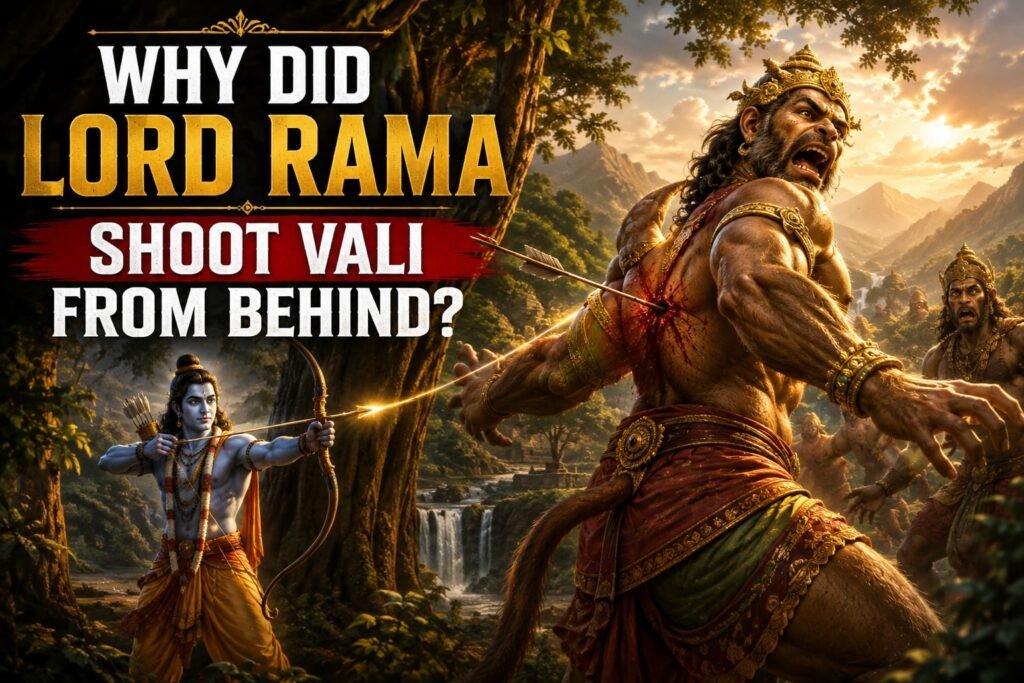
Among all the events described in the Ramayana, few have generated as much debate as Lord Rama’s decision to kill Vali from concealment rather than confronting him face to face. For many readers, the episode is genuinely surprising, since Rama is revered throughout Hindu tradition as Maryada Purushottam, the ideal embodiment of righteousness and dharma. If he always upheld justice so consistently elsewhere in the epic, why would he choose a method that seems, at least on the surface, unfair to his opponent?
This question has been discussed for centuries by scholars, devotees, and commentators alike, and opinions remain genuinely divided even today. Some readers view Rama’s action as difficult to reconcile with the ideals expected of a warrior, while others consider it fully justified once the surrounding circumstances described in the Valmiki Ramayana are properly understood. Making sense of the incident requires looking well beyond the single arrow that struck Vali, and examining the political, moral, and spiritual context that shaped Rama’s decision long before that moment arrived. The full story involves two brothers, a broken kingdom, a powerful boon, and Rama’s own understanding of what his duty as a prince actually required of him.
Who Were Vali and Sugriva?
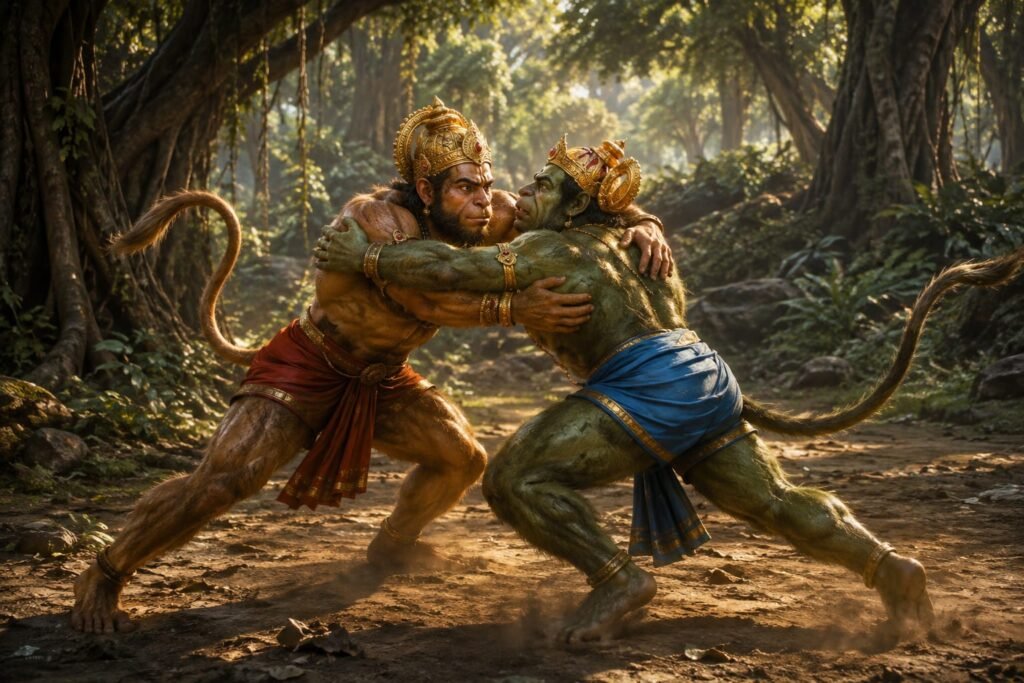
Vali and Sugriva were brothers who ruled together over the Vanara kingdom of Kishkindha. According to the Kishkindha Kanda of the Valmiki Ramayana, Vali was the elder of the two and the rightful king, widely admired for his extraordinary strength and unmatched courage in battle. Sugriva served him loyally for years until a single misunderstanding drove the two brothers permanently apart.
The conflict began when Vali entered a cave in pursuit of a powerful demon named Mayavi. After waiting outside the entrance for many days without any sign of his brother, Sugriva eventually saw blood flowing from within the cave and concluded that Vali had been killed in the fight. Fearing that the demon itself might emerge next, he sealed the cave’s entrance with a massive boulder and returned alone to Kishkindha. Believing Vali genuinely dead, the kingdom’s ministers crowned Sugriva as their new ruler to prevent Kishkindha from falling into chaos during the transition.
Vali, however, had survived the battle and eventually found his own way out of the cave. When he returned to Kishkindha and discovered Sugriva already seated on the throne, he assumed his younger brother had deliberately betrayed him rather than acted out of genuine fear and misunderstanding. Enraged by what he believed had happened, Vali reclaimed the kingdom by force, drove Sugriva into exile, and even took Ruma, Sugriva’s own wife, into his household. According to the Ramayana, this final act was regarded as a serious violation of dharma in its own right, and it became one of the central reasons behind Rama’s later decision to intervene in the brothers’ conflict at all.
Why Did Lord Rama Form an Alliance with Sugriva?
While searching for Goddess Sita after her abduction, Rama and Lakshmana arrived near Rishyamukha Mountain, where Sugriva had taken refuge following his exile. It was here that Hanuman first encountered Rama and quickly recognized his noble character, going on to introduce him to Sugriva, who explained in detail the injustice he had suffered at his elder brother’s hands.
Sugriva promised to help Rama in his search for Sita if Rama, in turn, would help him reclaim his rightful place as king of Kishkindha. The two sealed this agreement through a sacred vow taken before fire, symbolizing the depth of trust and mutual commitment between them. This alliance would go on to become one of the most significant partnerships in the entire epic, eventually leading both to the restoration of Sugriva’s kingdom and to the discovery of Sita’s location in Lanka.
It is worth noting, however, that Rama did not agree to help Sugriva simply because the two had become allies through circumstance. According to the Valmiki Ramayana, Rama genuinely believed that Vali had acted against dharma by taking his younger brother’s wife and depriving him of his rightful place as ruler. Protecting the innocent and standing against clear injustice formed an important part of Rama’s understood duty as a prince of the Ikshvaku dynasty, which meant his intervention in Kishkindha’s affairs was framed as a matter of righteousness rather than personal loyalty to a new friend alone.
Vali’s Divine Boon
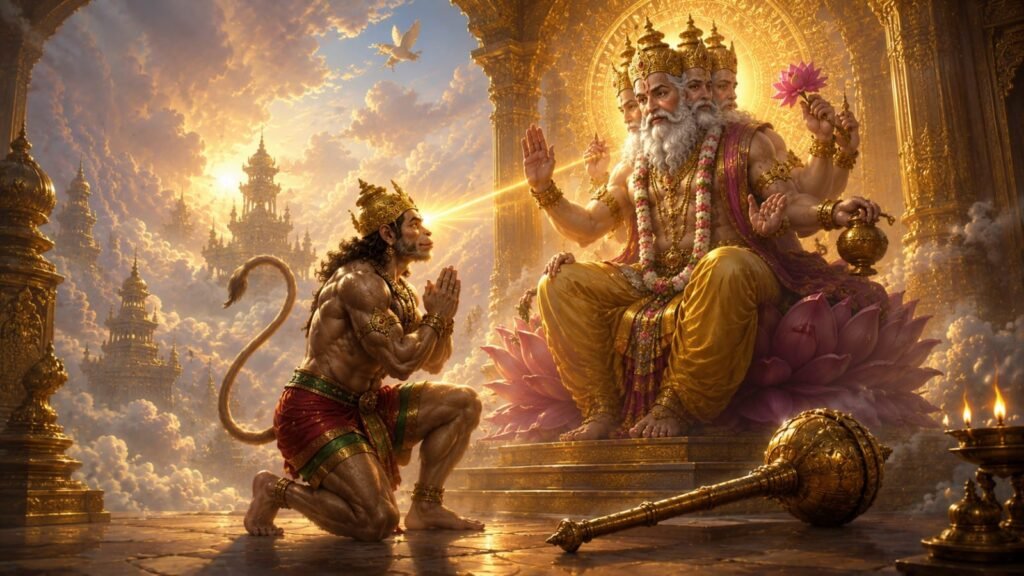
One of the most important details often overlooked in popular retellings of this story is the extraordinary boon Vali had received. According to the Ramayana, Vali possessed a blessing that allowed him to absorb half the strength of any opponent who fought him directly, face to face. As a result, every battle he entered made him progressively stronger while simultaneously weakening whoever stood against him, rendering him almost impossible to defeat through conventional, open combat.
This boon had already allowed Vali to overcome numerous powerful warriors over the years, establishing him as one of the strongest beings of his era by reputation alone. Even Sugriva, despite his own genuine courage, stood essentially no chance against his elder brother in a fair fight, since Vali’s divine advantage overwhelmed him in every duel the two had previously attempted. Rama understood clearly that challenging Vali through open combat would not only put the entire mission to rescue Sita at unnecessary risk, but would also make actually defeating Vali nearly impossible regardless of skill or preparation.
For this reason, the Valmiki Ramayana presents Rama’s eventual strategy as a practical response to a genuinely unique problem, rather than as an attempt to avoid a fight he might otherwise have lost through cowardice. The specific circumstances surrounding Vali’s boon became one of the central reasons behind Rama’s decision to strike from concealment, a choice that would soon become the subject of one of the most memorable and closely examined debates found anywhere in the epic.
Why Did Lord Rama Shoot Vali from Behind?
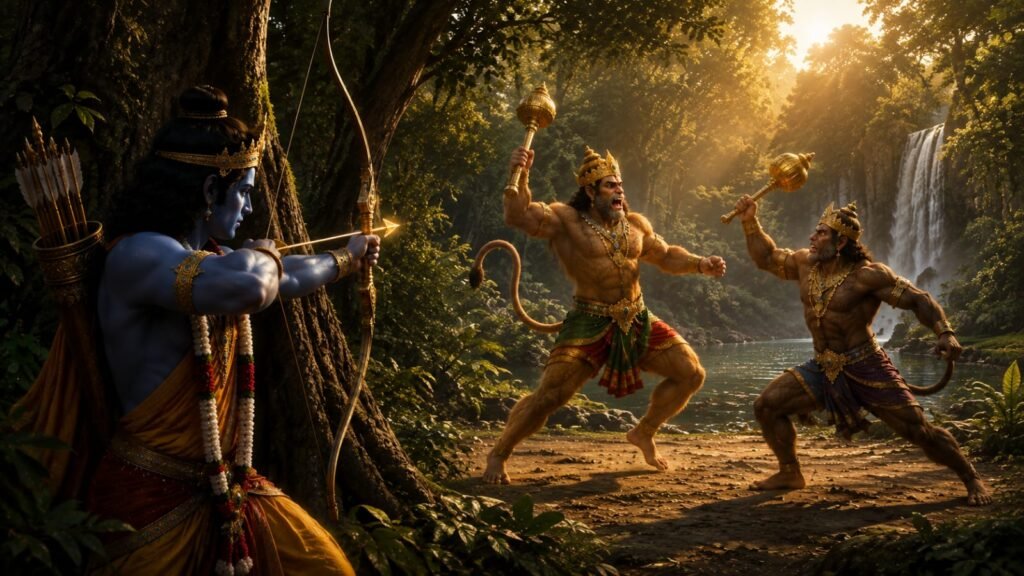
When Sugriva first challenged Vali to combat, Rama found it genuinely difficult to distinguish between the two brothers during the fight itself, since they resembled one another closely enough to make a clean shot risky. To avoid the possibility of striking the wrong person entirely, Rama chose not to release his arrow during that first encounter. Before the second duel took place, Sugriva wore a distinctive garland of flowers specifically so that Rama could identify him clearly from a distance. As the two brothers fought once more, Rama waited for the right opportunity and released a single arrow from behind a tree, striking Vali with a mortal wound.
At first glance, this method understandably appears unusual, particularly since warriors within ancient epic tradition were generally expected to meet one another in open, direct combat. The Valmiki Ramayana, however, frames the situation quite differently from an ordinary duel between equals. Rama was not personally engaged in a contest with Vali in the way Sugriva was, but was instead carrying out what he understood as his duty to address a ruler who had already violated dharma through his treatment of Sugriva. Since Vali’s boon made direct confrontation nearly impossible to win outright, Rama chose a strategy intended to secure justice while avoiding what could otherwise have become a far more costly and uncertain conflict.
This episode also reflects Rama’s broader role as a prince responsible for upholding righteousness beyond the narrow borders of his own kingdom. His intervention is presented throughout the text as motivated by neither revenge nor personal gain, but by his conviction that a ruler who had abused his power and violated established moral law deserved to face consequences, regardless of how strong or respected he otherwise remained.
Vali Questions Lord Rama
After being struck by Rama’s arrow, Vali did not simply accept what had happened to him without protest. According to the Kishkindha Kanda, he questioned Rama directly as he lay wounded, asking why a prince so widely celebrated for his righteousness had chosen to attack him from behind rather than facing him openly as an equal. Vali argued that he personally had no conflict whatsoever with Rama, and that the method used against him seemed to violate the basic principles of fair combat that warriors were expected to honor.
Vali also reminded Rama that the dispute in question was strictly a matter between two brothers of the Vanara kingdom, and questioned openly why an outsider had chosen to involve himself at all. From Vali’s own perspective, Rama had inserted himself into a conflict that did not concern him directly, and had done so using a method that seemed genuinely inconsistent with the ideals expected of a noble warrior. His pointed questions form one of the most significant philosophical exchanges found anywhere in the Ramayana.
Rather than responding with anger or defensiveness, Rama is described answering calmly, laying out the reasoning behind his decision in full. The extended dialogue that follows this confrontation stands as one of the epic’s most important discussions on justice, kingship, and dharma, and it is written in a way that clearly invites thoughtful reflection from the reader rather than simply presenting the episode as a straightforward battle between good and evil.
How Did Lord Rama Justify His Decision?
Rama explained to Vali that his actions had crossed a clear boundary of dharma. By taking Ruma, the wife of his younger brother Sugriva, and seizing both his kingdom and his household in the process, Vali had committed what Rama considered a serious moral offense. According to Rama’s own reasoning, a ruler who violated righteousness in this particular way could rightfully face punishment, regardless of his personal strength or elevated position within his own kingdom.
Rama further stated that, as a prince of the Ikshvaku dynasty, it was his responsibility to uphold justice wherever adharma had clearly taken hold, without regard for whether the wrongdoing occurred within his own borders or elsewhere. He believed that protecting the innocent and addressing wrongdoing directly was not something limited by geography or political jurisdiction. Since Sugriva had specifically sought his protection, and since Vali had, in Rama’s assessment, clearly abused his authority over his own brother, Rama considered intervention his responsibility rather than an optional favor extended to a new ally.
Hearing this explanation in full, Vali gradually came to accept the reasoning behind what had happened to him. Recognizing the mistakes he had made in his treatment of Sugriva, he expressed genuine remorse and asked Rama specifically to look after his son Angada once he was gone. Rama assured him that Angada would be treated with honor going forward, and that Sugriva would go on to rule Kishkindha justly in his brother’s place. Vali’s eventual acceptance of Rama’s explanation marks the close of their debate and clears the way for peace to be restored across the Vanara kingdom.
Was Lord Rama’s Action Against Dharma?
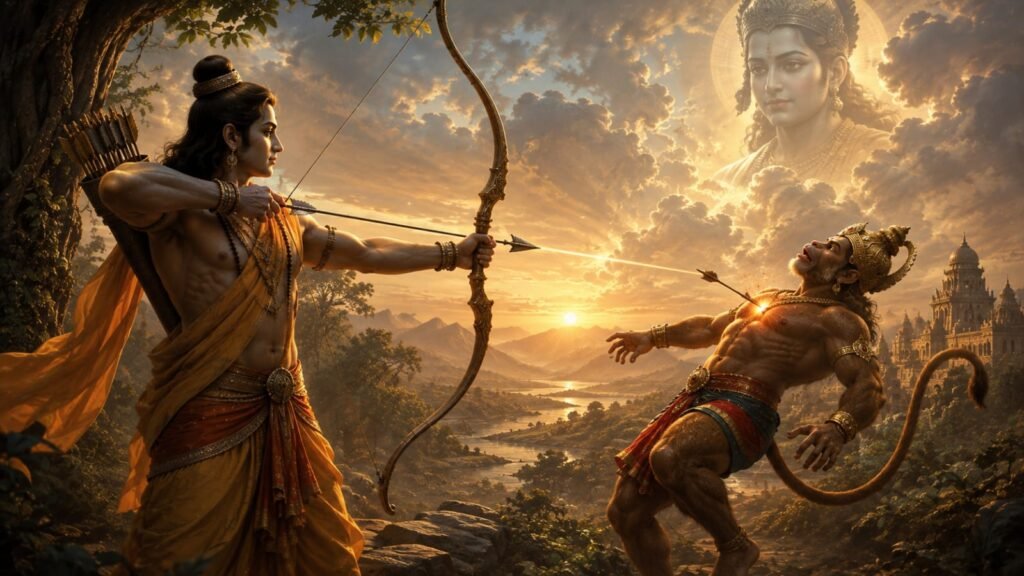
Even today, many readers continue to ask whether Rama genuinely acted against dharma by killing Vali from a position of concealment. The Valmiki Ramayana does not present this episode as a simple question with an obvious right or wrong answer. Instead, it portrays the entire incident as a complex moral dilemma, one in which Rama, acting as both a prince and a protector of righteousness, had to weigh compassion against justice rather than choosing between an easy hero and an easy villain. This inherent complexity is precisely why the incident has remained a subject of genuine discussion for centuries rather than fading into settled consensus.
From Rama’s own perspective, Vali had committed clear violations of dharma by unjustly seizing Sugriva’s kingdom and taking Ruma, his younger brother’s wife, without any legitimate justification. Rama believed that a ruler who misused his power in this way deserved punishment regardless of his strength or reputation, and since Vali’s boon made direct confrontation nearly unwinnable through conventional means, Rama considered his chosen method the only practical path toward restoring justice and protecting Sugriva going forward.
At the same time, the Ramayana does not shy away from the genuine ethical questions Vali himself raises in the aftermath. By allowing Vali to challenge Rama’s actions directly and at length, the epic actively encourages readers to think carefully about justice, duty, and leadership rather than accepting Rama’s perspective automatically simply because of who he is. Rather than offering easy answers, the text invites ongoing reflection on how dharma can sometimes involve genuinely difficult choices in which every available option carries real moral weight and consequence.
Different Interpretations Across Ramayana Traditions
The account of Vali’s death is narrated primarily in the Valmiki Ramayana, widely regarded as the oldest and most authoritative version of the epic. Later works, including the Ramcharitmanas by Goswami Tulsidas and the Adhyatma Ramayana, also describe this same event, though these retellings often place greater emphasis on Rama’s divine nature and the spiritual purpose behind his actions rather than dwelling on the ethical debate itself in as much detail.
Many traditional commentators explain that Rama acted not merely as an individual prince settling a personal grievance, but as an active upholder of dharma more broadly. From this perspective, Vali’s punishment was necessary precisely because he had abused his authority, violated basic family ethics, and ignored the responsibilities expected of any righteous ruler, regardless of his considerable personal strength. Other commentators focus more specifically on the practical realities of Vali’s boon, arguing that a direct battle would have been both impractical and genuinely contrary to Rama’s larger and more urgent mission of rescuing Sita and eventually confronting Ravana. A further line of traditional reasoning, offered by some scholars, points to Vali’s identity as a Vanara rather than a human warrior, suggesting that the formal codes of open, honorable combat expected between two Kshatriya princes did not automatically apply in the same way to an encounter that more closely resembled the hunting of a powerful wild creature.
Modern readers and scholars continue to interpret this episode in genuinely different ways even now. Some view it primarily as a lesson in the difficult and often uncomfortable responsibilities that come with real leadership, while others see it as an example of how ancient epics frequently present moral questions without offering simple or entirely comfortable answers. This ongoing diversity of interpretation is itself one of the main reasons the story of Rama and Vali remains one of the most actively discussed episodes found anywhere in the Ramayana.
Conclusion: Understanding Why Lord Rama Killed Vali from Behind
The story of Vali’s death remains one of the most debated episodes in the entire Ramayana, but it cannot be properly understood by focusing only on the single moment when Rama released his arrow. The Valmiki Ramayana presents a far broader picture, one involving Vali’s extraordinary boon, his treatment of Sugriva, and Rama’s own sense of duty as a prince of the Ikshvaku dynasty. When these elements are considered together rather than in isolation, Rama’s decision becomes part of a larger and more genuine discussion about justice, rather than a simple act of warfare judged on appearances alone.
The epic also deliberately gives Vali the opportunity to question Rama directly, allowing readers to hear both sides of the argument in full rather than only Rama’s justification. Rama’s response, grounded in Raj Dharma, moral responsibility, and the punishment of clear wrongdoing, forms one of the Ramayana’s most significant philosophical discussions on power and its limits. Whether a reader’s sympathies lean toward Vali’s challenge or Rama’s justification, the exchange is written to encourage genuine reflection rather than simple, unquestioning acceptance of either side.
Ultimately, this episode reminds readers that dharma is often far more complex than it first appears from a distance. The Ramayana does not present Rama as someone who avoided difficult or uncomfortable decisions, but as a ruler willing to accept personal criticism, even from the very man he had struck down, in order to fulfill what he genuinely believed was his duty. That willingness to be questioned, rather than simply obeyed, is part of why the story of Vali’s death continues to inspire debate, reflection, and spiritual learning thousands of years after it was first told.
Frequently Asked Questions
Why did Lord Rama kill Vali from behind?
According to the Valmiki Ramayana, Rama killed Vali from behind because Vali possessed a divine boon that made direct combat nearly impossible to win. Rama also believed Vali had violated dharma by seizing Sugriva’s kingdom and his wife Ruma.
What boon did Vali receive?
Vali received a boon that allowed him to absorb half the strength of anyone who fought him face to face, making him almost impossible to defeat through direct, open combat.
Why did Rama help Sugriva?
Rama formed an alliance with Sugriva after Sugriva promised to help him find Sita. Rama also believed Sugriva had been treated unjustly by Vali and deserved to regain his rightful kingdom.
Did Vali question Rama’s actions?
Yes. After being struck by the arrow, Vali questioned Rama directly, asking why he had attacked from behind instead of fighting openly. This exchange is recorded in the Kishkindha Kanda of the Valmiki Ramayana.
How did Rama justify killing Vali?
Rama explained that Vali had violated dharma by taking his younger brother’s wife and abusing his royal authority. As a prince responsible for upholding justice, Rama believed it was his duty to address such wrongdoing wherever it occurred.
Did Vali accept Rama’s explanation?
Yes. After hearing Rama’s reasoning, Vali acknowledged his mistakes, expressed remorse, and requested that Rama protect his son Angada. Rama accepted this request and later ensured Angada was treated with honor.
Which scripture describes the story of Vali’s death?
The primary account is found in the Valmiki Ramayana, specifically within the Kishkindha Kanda. The event is also narrated in later works such as the Ramcharitmanas and the Adhyatma Ramayana.
What lesson does the story of Vali teach?
The episode teaches that leadership and justice often involve difficult and uncomfortable decisions. It also highlights the importance of dharma, the responsible use of power, and the value of examining situations from multiple perspectives rather than judging them at first glance alone.+