
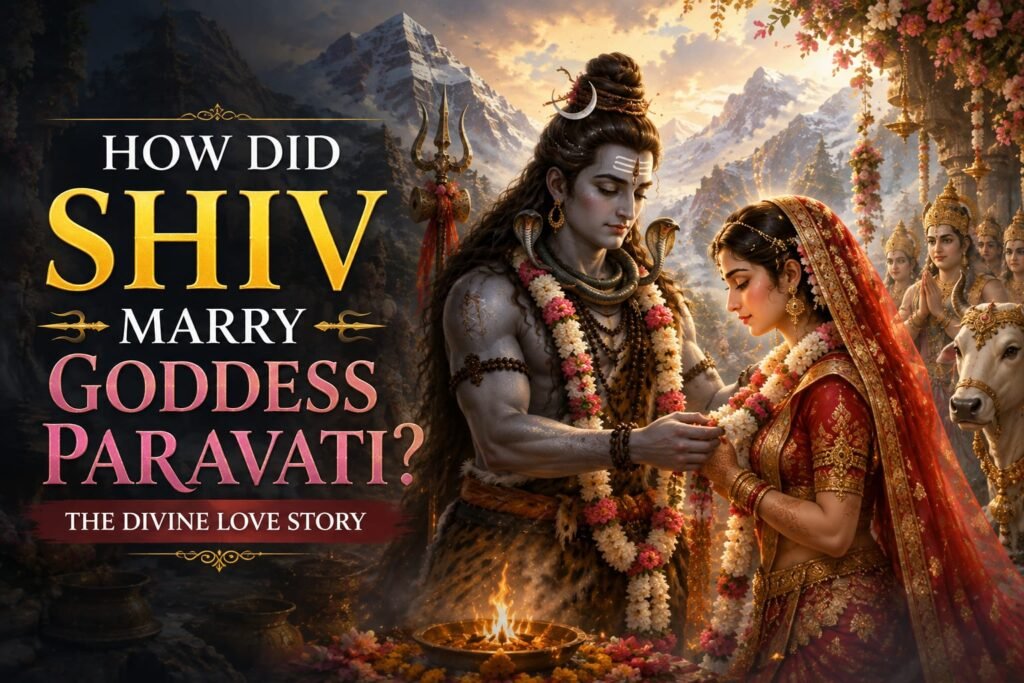
Few love stories in Hindu mythology carry as much patience, sacrifice, and cosmic consequence as the marriage of Shiva and Parvati. This is not a simple tale of two people falling in love. It is a story that spans two lifetimes, involves the intervention of gods, and even requires the sacrifice of Kamadeva, the god of desire himself. Understanding how did Shiva marry Goddess Parvati means tracing a narrative that Hindu tradition treats as central to the balance between asceticism and householder life, and between destruction and creation.
What sets this story apart from many other divine romances is how openly it acknowledges failure, grief, and delay before arriving at union. Rather than presenting Shiva and Parvati’s marriage as something destined to happen smoothly, the Puranas take care to show every obstacle along the way, a father’s cruelty, a devastating loss, a failed intervention by the gods, and years of solitary penance. This willingness to dwell on hardship rather than skip past it is part of why the story has remained so central to Hindu devotional literature, offering not just an account of two deities coming together, but a detailed meditation on what genuine devotion actually demands.
How Sati’s Death by Fire Set the Stage for Parvati’s Story
To understand Parvati’s marriage to Shiva, it helps to start one life earlier. According to the Shiva Purana and other Puranic texts, Shiva’s first wife was Sati, daughter of King Daksha. Sati married Shiva against her father’s wishes, since Daksha disapproved of Shiva’s ascetic lifestyle, his matted hair, his ash covered body, and his preference for cremation grounds over royal palaces. Daksha never fully accepted his daughter’s choice, and this resentment simmered for years even after the marriage had taken place, coloring every interaction between the two households.
This tension eventually led to a tragic event. According to the Puranas, Daksha organized a grand yajna, a fire sacrifice, and deliberately did not invite Shiva or Sati, treating the omission as a calculated insult rather than an oversight. Sati learned of the event and, against Shiva’s advice, chose to attend anyway, hoping her presence would soften her father’s attitude toward her husband. Instead, she was met with public humiliation, as Daksha spoke against Shiva in front of the assembled gods and sages. Unable to bear this insult to the person she loved, Sati is described as immolating herself in the sacrificial fire, ending her life in an act driven by grief and wounded devotion rather than despair alone.
Grief stricken by her death, Shiva is said to have withdrawn from the world entirely, carrying her body across the heavens in sorrow before eventually retreating into deep meditation and complete detachment from worldly affairs. This period of mourning is often described in the Puranas as one of the deepest expressions of loss found anywhere in Hindu mythology, setting the emotional tone for everything that follows in the story of Parvati. This backstory matters because Hindu tradition presents Parvati not as an entirely new character, but as the reincarnation of Sati, born to continue what fate had interrupted.
Parvati’s Birth as the Daughter of the Himalayas
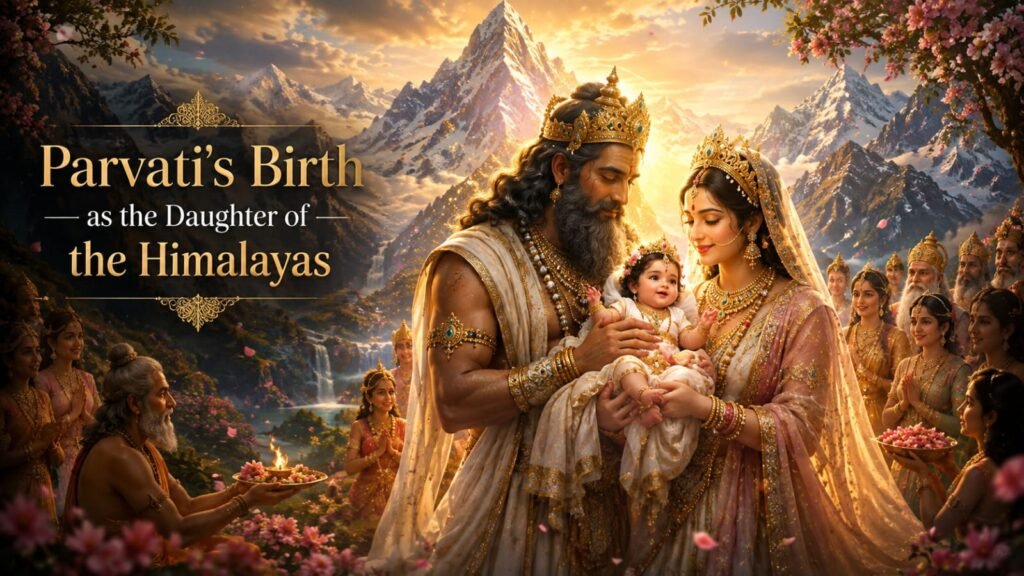
According to the Puranas, Sati was reborn as Parvati, the daughter of Himavan, the personification of the Himalayan mountains, and his wife Mena. Unlike an ordinary birth, this rebirth is described in ancient texts as carrying purpose from the very beginning, since Parvati is said to have shown an unusual, almost instinctive devotion toward Shiva even as a young girl, long before she fully understood the reason behind that pull. Growing up in the grandeur of the Himalayan court, she had access to comfort, status, and every advantage of royal life, yet none of it seemed to interest her the way stories of Shiva did.
However, by this point, Shiva had withdrawn into deep meditation after Sati’s death, showing no interest in worldly relationships or remarriage. He remained seated in austere isolation, indifferent to the passage of seasons, the concerns of kingdoms, or the affairs of gods. This left Parvati facing a significant challenge, since winning the attention of a god who had renounced desire entirely was no small task, and no ordinary means of courtship, gifts, arranged introductions, or family influence, could possibly reach him.
Why a Demon’s Boon Made This Marriage a Cosmic Necessity
The union of Shiva and Parvati was not simply a personal matter between two individuals. According to Puranic narratives, it carried cosmic significance that involved the gods directly, turning what might have remained a private matter of the heart into an event with consequences for the entire universe.
This urgency traces back to a demon named Tarakasura, who had performed severe penance and received a powerful boon as a result, that he could only be defeated by a son born specifically of Shiva. At the time this boon was granted, such a condition must have seemed nearly impossible to fulfill, since Shiva showed no inclination toward marriage or fatherhood. Once Tarakasura grew in power and began threatening the balance of the three worlds, however, that impossible condition became the very thing standing between the gods and their survival.
Indra and the other devas grew increasingly desperate as Tarakasura’s forces advanced, and according to the Puranas, they eventually realized that Shiva remaining in meditation indefinitely was no longer sustainable for the wider cosmos. This desperation is what led them to seek help from Kamadeva, the god of love and desire, asking him to intervene directly and stir feelings in Shiva that would draw him toward Parvati. What began as Parvati’s personal devotion became, through this development, entangled with the survival of the gods themselves.
When Kamadeva’s Arrow Brought Fury Instead of Love
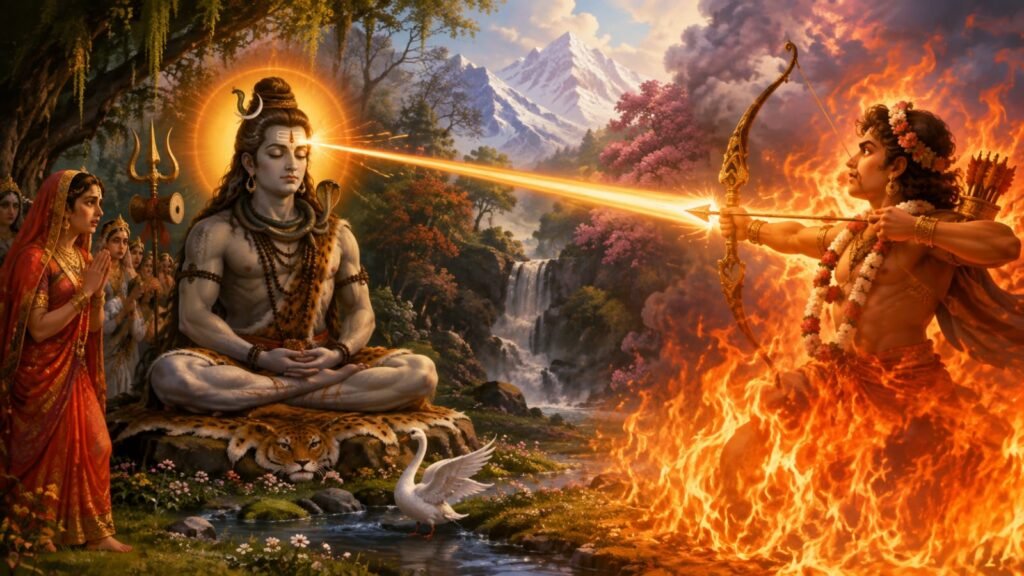
This part of the story is one of the most well known episodes connected to Shiva and Parvati’s union. According to the Shiva Purana, Kamadeva agreed to help the gods, approaching the meditating Shiva while Parvati happened to be nearby, and shot an arrow of desire at him in the hope of awakening romantic feeling where none had existed since Sati’s death.
The plan worked only partially, and with severe consequences. Ancient texts describe Shiva, disturbed from his meditation and angered by the sudden intrusion into his inner stillness, opening his third eye and reducing Kamadeva to ashes almost instantly, without pause or warning. The suddenness of this reaction reflects how seriously Shiva’s meditative state was regarded, not as something to be tampered with lightly, even for a cause the gods considered essential. This event is frequently cited as the reason Kamadeva is also known as Ananga, meaning bodiless, in later mythology, a name that stuck with him long after the incident itself had passed into legend.
Rati, Kamadeva’s wife, is described in the Puranas as devastated by her husband’s destruction, pleading with Shiva for mercy and refusing to accept that his existence had ended so abruptly. According to most versions of the story, Shiva was eventually moved by her sorrow and granted Kamadeva a formless existence, allowing his influence over desire to remain active in the world even without a physical body to inhabit. This episode is often interpreted symbolically rather than only literally. Many scholars believe it represents the idea that desire alone, without sincerity or spiritual discipline behind it, cannot awaken true union between two beings, let alone between a devotee and the divine. Something deeper than an arrow of longing was required for Parvati to actually reach Shiva, and the destruction of Kamadeva marks the point in the story where external tactics fail completely, clearing the way for a very different approach.
Choosing Hardship Over Shortcuts, Parvati’s Long Penance in the Forest
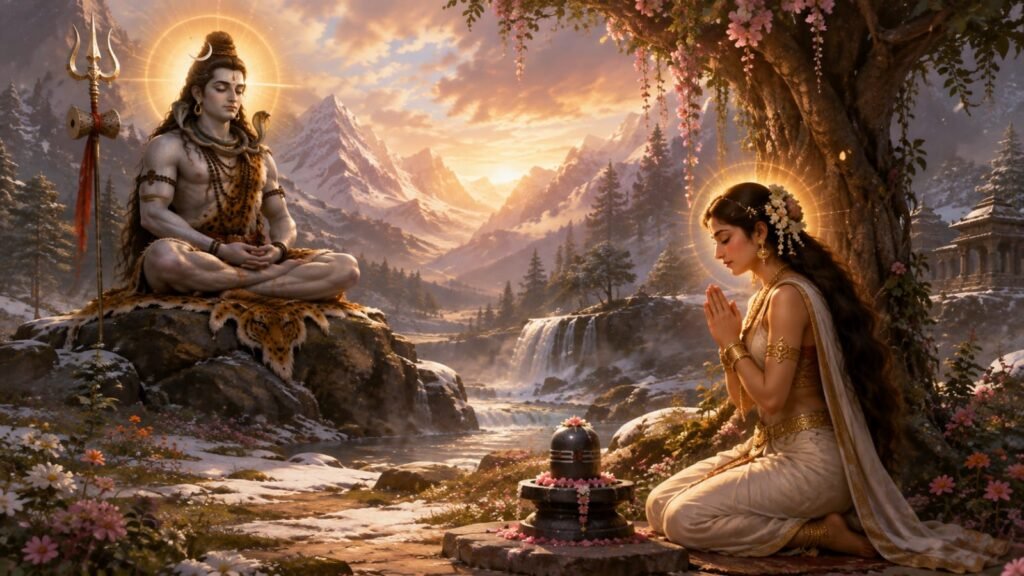
Following this event, Parvati did not give up, even though the method the gods had tried on her behalf had ended in disaster. According to the Puranas, she chose an entirely different approach from Kamadeva’s, replacing external disturbance with personal transformation through severe and prolonged penance of her own.
She left the comfort of her father’s palace and moved into the forest, choosing to live under conditions that stood in stark contrast to the royal upbringing she had known. Ancient texts describe her enduring the harshest extremes of both winter and summer without complaint, standing for long periods in freezing rivers and later surrounding herself with fire during the hottest months, all while maintaining her focus on Shiva. Over time she reduced her food intake gradually, moving from simple meals to fruit alone, and eventually, according to some traditions, giving up even leaves, which earned her the name Aparna, meaning one who does not eat even leaves. Throughout this period, her mind remained fixed entirely on Shiva through continuous meditation and prayer, rather than through any external appeal, gift, or intermediary.
This part of the story is significant in Hindu tradition because it shifts the emphasis away from divine intervention and toward personal spiritual effort. Parvati’s penance is often cited in devotional teaching as an example of dedication that goes far beyond ordinary romantic pursuit, showing a willingness to endure genuine hardship for the sake of a connection that offered no guarantee of success.
One Final Test Before Shiva Reveals His True Form
According to several Puranic versions, Shiva did not immediately respond to Parvati’s penance, even after being moved by the depth of her devotion. Instead, he is described as testing her resolve one final time before revealing himself, choosing to appear before her not as the god she sought, but in disguise as an elderly ascetic who began criticizing Shiva’s habits and lifestyle in front of her.
This disguised figure spoke of Shiva’s unconventional appearance, his preference for cremation grounds, his company of spirits and ganas, and his general unsuitability as a husband by the standards of ordinary society. Ancient texts describe Parvati defending Shiva firmly against every one of these criticisms, refusing to be swayed even when the arguments touched on the very qualities that made Shiva seem strange or frightening to outsiders. Her responses were not defensive in a superficial sense, but reflected a genuine understanding of why those unconventional qualities were, in her eyes, part of what made Shiva worth waiting for.
Satisfied by this unwavering devotion, Shiva is said to have finally dropped the disguise, revealed his true form before her, and accepted her penance as genuine rather than a passing infatuation shaped by curiosity or admiration alone. This interpretation varies slightly between regional tellings, but the core theme remains consistent across most versions. Parvati’s marriage to Shiva was not granted easily or quickly, unlike the swift responses Shiva is known for in other devotional contexts involving simple offerings. Her path required sustained effort over an extended period rather than a single sincere gesture.
A Himalayan Wedding Unlike Any Other in Hindu Mythology
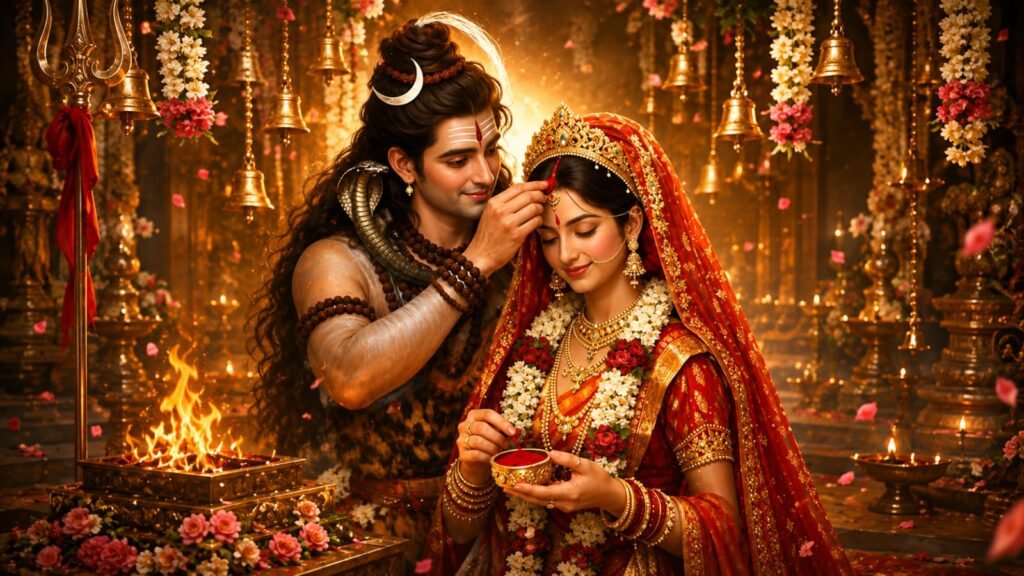
Once Shiva accepted Parvati, the wedding itself is described in the Puranas as a grand cosmic event, unlike any ordinary royal ceremony, attended by gods, sages, and celestial beings drawn from every corner of creation. According to tradition, the ceremony is generally placed near Mount Kailash or within the broader Himalayan region, reflecting Parvati’s identity as the daughter of Himavan and the natural setting of her family’s domain. Different regional traditions localize the event to specific sacred sites within the Himalayas, each claiming a particular valley or riverbank as the true location, though the core setting across most retellings remains rooted in this same mountainous landscape that had shaped Parvati’s entire upbringing.
Puranas describe Shiva arriving for the wedding accompanied by his unusual retinue of ganas, spirits, and ascetics, a procession that looked nothing like the disciplined, ornamented arrival expected of a typical bridegroom from a royal lineage. This initially unsettled Himavan and Mena, Parvati’s parents, who had anticipated a more conventional and dignified approach befitting their daughter’s status, and who reportedly felt a moment of doubt upon seeing the strange company Shiva brought with him. However, once Shiva’s true divine nature was revealed in full, their apprehension gave way to reverence, and they understood that his unconventional appearance was itself a reflection of who he truly was rather than a lack of respect for the occasion.
Gods, sages, and celestial musicians are described as attending the wedding in great numbers, filling the mountain setting with a presence rarely seen even in stories involving other major deities. The ceremony proceeded according to proper Vedic rites once Shiva’s identity and intentions were made unmistakably clear, blending the formal structure of traditional ritual with the extraordinary, otherworldly atmosphere that only a wedding involving Shiva could produce. The event is remembered in tradition as a rare moment where Shiva’s ascetic world and Parvati’s royal Himalayan household came together in a single celebration, each side adapting to accommodate the other rather than one overshadowing the second entirely.
What the Union of Shiva and Shakti Teaches About Balance
Beyond the narrative details, the marriage of Shiva and Parvati carries deep symbolic weight in Hindu philosophy and Shaiva tradition, offering more than a simple resolution to a long courtship.
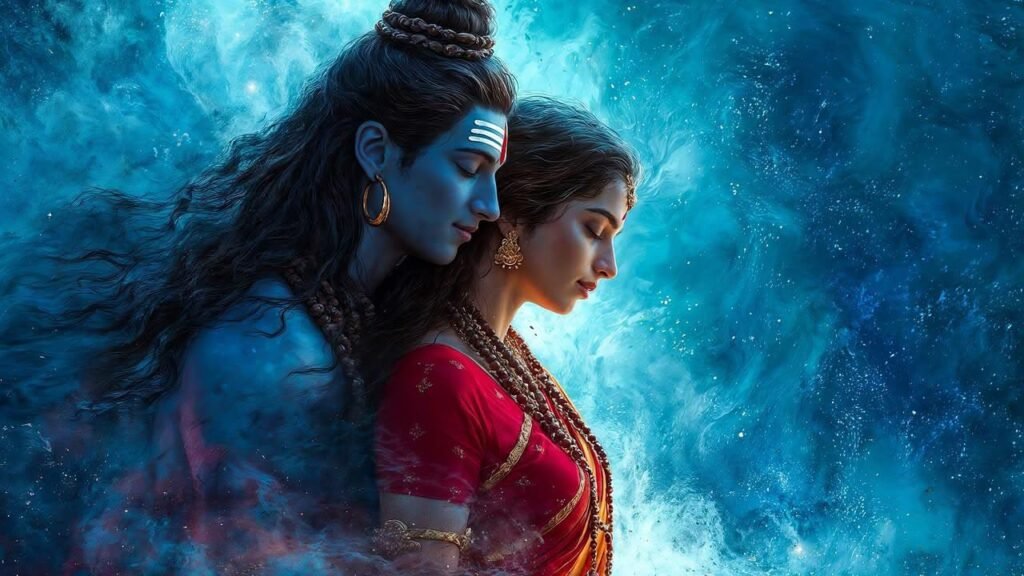
The union is often described as representing the balance between Purusha and Prakriti, consciousness and energy, a pairing frequently discussed in Hindu philosophical thought as the foundation of all creation. Parvati is seen in this framework as Shakti, the active, dynamic energy that complements Shiva’s stillness and detachment, together forming a complete cosmic whole rather than two separate, unrelated principles. This same marriage is also understood as an integration of the ascetic path with the responsibilities of householder life, suggesting that renunciation and worldly duty are not always opposing forces but can coexist within a single relationship. Their union eventually leads to the birth of their sons, Kartikeya and Ganesha, both of whom become significant deities in their own right and carry forward aspects of both parents’ natures into their own mythology.
Many scholars believe this story continues to resonate precisely because it presents divine love not as instant or effortless, but as something built gradually through patience, testing, loss, and mutual respect. These are values that Hindu tradition holds in high regard even within human relationships, which is part of why the story of Shiva and Parvati is retold so often during weddings, festivals, and devotional teachings across generations, serving as a model for what committed devotion can ultimately achieve.
Frequently Asked Questions
How did Shiva marry Goddess Parvati according to Hindu mythology?
According to the Puranas, Parvati, reborn from her previous life as Sati, won Shiva’s acceptance through years of intense penance. After the gods intervened through Kamadeva, whose sacrifice ultimately failed, Parvati’s personal devotion succeeded where external disturbance could not, leading Shiva to accept her and marry her in a grand celestial ceremony.
Why did Kamadeva try to disturb Shiva’s meditation?
The gods, worried about the demon Tarakasura who could only be defeated by Shiva’s son, asked Kamadeva to awaken romantic feelings in Shiva toward Parvati. Kamadeva shot an arrow of desire at Shiva, disturbing his meditation, which angered Shiva enough that he opened his third eye and reduced Kamadeva to ashes instantly.
Was Parvati the reincarnation of Sati?
Yes, according to the Shiva Purana, Parvati is described as the reincarnation of Sati, Shiva’s first wife, who had died after immolating herself following her father Daksha’s insult toward Shiva. Parvati was born as the daughter of Himavan, continuing the connection to Shiva that had been interrupted in her previous life.
Why did Shiva test Parvati before marrying her?
According to Puranic tradition, Shiva wanted to be certain of Parvati’s sincerity before accepting her penance as genuine devotion rather than temporary infatuation. He is described as appearing in disguise and criticizing himself to observe her reaction, and her unwavering defense of him confirmed the depth of her commitment.
What is the symbolic meaning of Shiva and Parvati’s marriage?
Their marriage is often interpreted as the union of Shiva, representing consciousness and stillness, with Parvati, representing Shakti, or dynamic energy. Many scholars believe this reflects a broader philosophical idea in Hindu tradition, that creation and cosmic balance require both principles together rather than either existing alone.
Where did the wedding of Shiva and Parvati take place?
Puranic descriptions generally place the wedding near Mount Kailash or within the broader Himalayan region, reflecting Parvati’s identity as the daughter of Himavan, the personification of the Himalayas. The exact location varies across regional tellings, since different traditions localize the event to specific sacred sites in the Himalayas.
What happened to Kamadeva after Shiva burned him?
According to the Puranas, Rati, Kamadeva’s wife, pleaded with Shiva for mercy after his destruction. Shiva eventually granted Kamadeva a formless existence, allowing his influence over desire to remain active in the world even without a physical body, which is why Kamadeva is also referred to as Ananga in later tradition.
Conclusion: A Meaningful Takeaway
The story of how Shiva married Goddess Parvati is rarely told as a simple romance, and that is precisely what makes it enduring. It is a story built on loss, patience, sacrifice, and tested devotion rather than instant attraction. Hindu tradition uses this narrative to show that meaningful union, whether divine or human, often asks for something deeper than desire alone. Parvati’s path to Shiva reminds readers that some of the most powerful relationships are shaped not by ease, but by the willingness to remain steady through trial, distance, and time.
This is also why the story continues to hold such an important place in Hindu devotional life beyond its narrative appeal alone. It is retold each year during Maha Shivratri, referenced in wedding traditions, and taught to children as an early lesson in what patience and sincerity can accomplish. For many, Parvati is not simply a mythological figure who succeeded in winning Shiva’s hand, but a model of what it looks like to pursue something meaningful without shortcuts, allowing the story to remain relevant far beyond the world of gods and goddesses it originally describes.