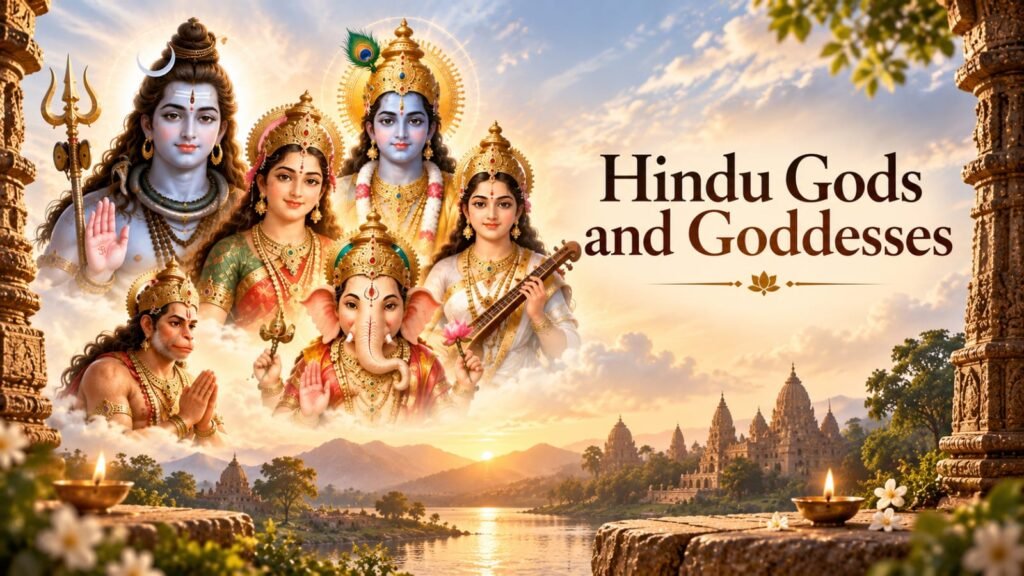
Hindu Gods and Goddesses have been an essential part of Indian spiritual and cultural traditions for thousands of years. From the powerful presence of Shiva and Parvati to the wisdom associated with Saraswati, the prosperity represented by Lakshmi, and the protective strength of Durga and Kali, each divine figure carries stories, symbolism, and teachings that have continued across generations.
Understanding Hindu Gods and Goddesses is not simply about learning the names of different deities. Their stories often explore deeper ideas about dharma, devotion, knowledge, courage, compassion, destruction, creation, and the eternal relationship between human beings and the divine. This is why Hindu mythology has remained such a vast and fascinating tradition.
For generations, Hindu communities have preserved these traditions through mythology stories, scriptures, oral traditions, temple practices, festivals, literature, and countless retellings. Some stories come directly from ancient texts, while others developed through regional traditions and popular storytelling. Understanding this distinction is important when exploring Hindu mythology explained through modern sources.
Stories of Hindu Deities
Hindu Gods and Goddesses represent different expressions of the divine within Hindu traditions. Unlike the idea that every deity must necessarily represent a completely separate god, Hindu philosophical traditions can understand the many forms of divinity in different ways.
Some traditions emphasize one supreme reality appearing through many forms, while devotional traditions may focus intensely on a particular deity such as Vishnu, Shiva, Devi, or Krishna.
This diversity is one of the defining characteristics of Hindu mythology culture. The same divine figure can have different names, forms, stories, and regional traditions while remaining connected to a broader spiritual framework.
For example, Hindu traditions associate Shiva with transformation, meditation, destruction, and regeneration. Hindu traditions also associate Vishnu with preservation and describe how he appears through various avatars when cosmic balance faces a threat. Devi appears in many powerful forms, including Durga, Parvati, and Kali.
These different forms help explain why Hindu Gods and Goddesses occupy such an important place in Hindu religious and cultural life.
Stories of Hindu Deities
Many of the most famous Hindu Gods and Goddesses have gained recognition through stories that generations have passed down. These stories appear across the Vedas, Puranas, Ramayana, Mahabharata, and other Hindu traditions.
Indian mythological tales often combine divine events with questions about morality, human behavior, duty, and the consequences of one’s choices.
Hindu epic stories such as the Ramayana and Mahabharata contain some of the most influential narratives in Indian civilization. People remember these characters not merely for their supernatural powers, but for the choices they make and the complex ideas those choices reveal about dharma, loyalty, sacrifice, ambition, and righteousness.
Similarly, Hindu god stories surrounding Shiva, Vishnu, Krishna, Ganesha, and other deities have inspired generations of artists, writers, storytellers, and devotees.
Many Indian mythological stories are therefore much more than entertainment. They have helped communicate philosophical and cultural ideas in a form that ordinary people could remember and pass down.
Shiva and Parvati: A Story of Divine Union
Among the most widely known Hindu mythology stories is the relationship between Shiva and Parvati.
Hindu traditions describe Parvati as the daughter of Himavan, the personification of the Himalayas. She undertakes intense devotion and spiritual discipline with the desire to unite with Shiva.
The story of Parvati and Shiva explores devotion, perseverance, spiritual determination, and the union of complementary forces.
Hindu traditions often portray Shiva as an ascetic detached from worldly matters, creating a powerful contrast with Parvati’s determined devotion. Their union eventually becomes one of the central divine relationships in Hindu tradition.
Their family also includes important figures such as Ganesha and Kartikeya, giving rise to numerous stories that remain popular throughout India.
Different Hindu traditions interpret the symbolism of Shiva and Parvati in several ways. Their relationship often represents the balance between consciousness and energy, asceticism and worldly life, and destruction and creation.
The Story of Kali and Shiva
The Kali Shiva story is another powerful example of how Hindu mythology presents different forms of divine energy.
Kali is one of the most intense manifestations of the Goddess. Hindu traditions often associate her with time, transformation, the destruction of evil, and a power that extends beyond ordinary human limitations.
Popular Hindu traditions connect Kali’s fierce form with battles against forces of evil.Her appearance can seem frightening, but the symbolism behind her is not simply about violence. Kali can also represent the destruction of ignorance, ego, fear, and destructive forces.
Different Hindu traditions interpret stories involving Shiva and Kali in various ways. In some popular narratives, Shiva’s presence helps restore balance when Kali’s fierce energy becomes overwhelming.
This highlights an important feature of Hindu legends: the same story can carry several layers of meaning, depending on the text, region, philosophical tradition, or devotional community that interprets it.
Why Are There So Many Hindu Deities?
One of the most common questions about Hindu Gods and Goddesses is why Hindu traditions contain so many divine forms.
The answer lies in the diversity of Hindu philosophy itself.
Rather than requiring one single interpretation, Hindu traditions have historically allowed different philosophical and devotional approaches to coexist. Some traditions emphasize Brahman, the ultimate reality, while others focus devotionally on a particular form of God or Goddess.
This explains why Hindu mythology characters appear in countless stories while remaining connected to broader spiritual ideas.
People widely worship Ganesha as the remover of obstacles and associate him with wisdom and auspicious beginnings. People also associate Lakshmi with prosperity and abundance, while Saraswati represents knowledge, learning, music, and the arts. Durga represents protective and powerful feminine energy.
Each deity therefore has a distinctive identity, but their stories also participate in a much larger spiritual and cultural tradition.
Hindu Mythology Beliefs and Their Cultural Importance
Hindu mythology beliefs have influenced Indian culture in ways that extend far beyond religious worship.
Temples, festivals, classical dance, music, sculpture, painting, literature, theatre, television, and everyday traditions have all drawn inspiration from stories involving Hindu Gods and Goddesses.
Different divine traditions and narratives shape festivals such as Diwali, Navratri, Janmashtami, Ganesh Chaturthi, and Maha Shivaratri.
Hindu mythology and culture have also shaped the way families share stories. Parents and grandparents have traditionally passed Hindu stories down to younger generations, helping preserve cultural memory even as people retell these stories in different forms.
This is one reason ancient Hindu mythology continues to remain relevant in modern India.
Hindu Mythology History: From Ancient Texts to Modern Retellings
No single book or historical period can fully capture the history of Hindu mythology.
Ancient Indian mythology developed through a broad collection of texts and traditions. The Vedas represent some of the oldest surviving Sanskrit religious literature, while the epics and Puranas contain extensive narratives about deities, heroes, sages, cosmic events, and sacred traditions.
Ancient Hindu mythology has therefore evolved through multiple layers of literature and oral transmission.
Over time, people have retold these stories in regional languages and adapted them into different cultural forms. Hindi mythological stories, for example, have helped introduce traditional narratives to Hindi-speaking audiences through books, television, films, and oral storytelling.
Modern readers can also find these traditions through Hindu mythology books and contemporary interpretations. Some works focus closely on scripture, while others present creative retellings from the perspective of individual Hindu mythology characters.
Hindu Mythology Books and Mythological Novels
The popularity of Hindu mythology has created a large literary tradition.
Hindu mythology books range from translations and explanations of ancient scriptures to modern interpretations of familiar stories. Readers can find works discussing the Ramayana, Mahabharata, Puranas, individual deities, and specific philosophical traditions.
Indian mythological novels have also become increasingly popular because they allow authors to explore familiar stories from fresh perspectives.
However, readers should remember that a modern novel is not necessarily the same thing as a traditional scripture . A fictional retelling may add dialogue, motivations, events, or interpretations that ancient texts do not explicitly describe.
Similarly, a Hindu myths book may present one particular interpretation rather than representing every Hindu tradition.
Knowing the difference between scripture, traditional legend, scholarly interpretation, and modern fiction makes it easier to understand Hindu mythology without confusing different sources.
Hindu Legends and the Meaning Behind Them
Hindu legends often contain lessons that remain relevant even when separated from their supernatural elements.
Rama’s stories emphasize ideals such as duty and righteousness. Krishna’s stories explore devotion, wisdom, strategy, and dharma. Tales of Ganesha often highlight intelligence and the ability to overcome obstacles. Meanwhile, stories of Durga and Kali portray the triumph of divine power over destructive forces.
These Hindu legends have survived partly because they allow different generations to discover different meanings within the same narrative.
A child may remember a story because of its exciting events, while an adult may later understand its deeper philosophical symbolism.
The layered nature of these stories helps explain why people continue to retell Hindu stories across centuries.
Hindu Epic Stories and Their Characters
Two major sources of Indian storytelling are the Ramayana and the Mahabharata.
The Ramayana tells the story of Rama, Sita, Lakshmana, Hanuman, Ravana, and many other important characters. The Mahabharata presents the complicated conflict involving the Pandavas, Kauravas, Krishna, Draupadi, Bhishma, Arjuna, Karna, and numerous other figures.
These Hindu epic stories are not simple tales of good characters fighting bad characters. Many characters face difficult choices in which duty, personal relationships, ambition, morality, and destiny collide.
That complexity is part of what makes Hindu mythology characters so enduring.
The stories invite readers to ask difficult questions rather than simply providing straightforward answers.
What Is the Difference Between Scripture and Popular Hindu Stories?
A major challenge when studying Hindu mythology is separating scriptural tradition from popular storytelling.
Not every story commonly described as part of Hindu mythology appears in exactly the same form in an ancient scripture.
Some stories originate in particular Puranas or regional traditions. Others have developed through oral storytelling, devotional literature, temple traditions, folk narratives, or modern adaptations.
Therefore, when exploring mythology Hindu stories, it is useful to ask where a particular version comes from.
A responsible discussion of Hindu Gods and Goddesses should distinguish between what an ancient text actually says and what later tradition or popular culture has added.
This does not necessarily make one version “false.” Different Hindu traditions have historically preserved different interpretations and narratives.
Instead, understanding the source gives the reader a clearer picture of how Hindu mythology developed.
Why Do Hindu Deities Remain Relevant Today?
Hindu Gods and Goddesses remain relevant because their stories continue to address universal human experiences.
People still struggle with fear, ambition, loss, relationships, responsibility, pride, devotion, and the search for meaning.
The stories of these deities offer symbolic ways to explore these experiences.
People often understand Shiva through themes of transformation and detachment.. Parvati can represent devotion and determination. Durga represents strength against destructive forces. Saraswati symbolizes knowledge and creativity. Lakshmi represents prosperity and abundance. People associate Ganesha with wisdom and overcoming obstacles.
These interpretations help explain why Hindu mythology stories continue to appear in contemporary books, films, art, television, festivals, and online discussions.
Hindu Mythology Explained: What Should We Take From These Stories?
Hindu mythology explained simply is not about memorizing every deity, genealogy, or supernatural event.
It is about understanding the ideas and traditions behind the stories.
Hindu mythology combines religion, philosophy, literature, cultural memory, symbolism, and regional traditions. Its enormous diversity means that no single story or interpretation can represent every Hindu belief.
The most meaningful way to approach these traditions is with curiosity and attention to their sources.
Whether someone discovers these narratives through ancient texts, Hindu mythology books, temple traditions, Indian mythological stories, or modern retellings, the stories can offer a fascinating window into India’s religious and cultural history.
Frequently Asked Questions
Who Are the Most Important Hindu Deities?
Hindu traditions do not universally rank Hindu Gods and Goddesses in any particular order. Different Hindu traditions place different deities at the center of devotion. People widely worship and recognize Shiva, Vishnu, Devi, Krishna, Rama, Ganesha, Lakshmi, Saraswati, Durga, and Parvati as important divine figures in Hindu traditions.
What are Hindu mythology stories?
Hindu mythology stories are traditional narratives involving gods, goddesses, sages, heroes, demons, cosmic events, and moral or philosophical themes. They come from a wide range of texts and regional traditions rather than from one single source.
Are All Hindu Myths in Ancient Scriptures?
No. Some stories have clear scriptural sources, while others developed through regional traditions, oral storytelling, devotional literature, and later retellings. This is why different versions of the same story can sometimes exist.
What is the Kali Shiva story?
The Kali Shiva story refers to traditions involving the fierce Goddess Kali and Shiva. Different texts and traditions tell these narratives differently, but they commonly explore themes of divine power, transformation, destruction, and restoration of cosmic balance.
What is the Parvati Shiva story?
The story of Parvati and Shiva explores their relationship through themes of devotion, perseverance, spiritual discipline, and divine union. Their marriage and family form an important part of many Hindu traditions.
Where can I learn more about Hindu mythology?
Readers can explore translations of traditional scriptures, scholarly works, Hindu mythology books, Indian mythological novels, temple traditions, and reputable educational resources. Comparing multiple sources is particularly useful because Hindu traditions contain considerable regional and philosophical diversity.
Conclusion
Hindu Gods and Goddesses represent one of the world’s richest and most diverse traditions of religious storytelling. Their stories have survived through scriptures, epics, Puranas, oral traditions, temples, festivals, literature, and generations of cultural transmission.
From the relationship between Shiva and Parvati to the fierce symbolism of Kali, from the wisdom of Ganesha to the protective power of Durga, each divine form carries its own stories and meanings.
The greatest value of studying Hindu mythology is not simply learning what happened in each story. It is understanding why these narratives have remained meaningful for so many generations.
Hindu Gods and Goddesses continue to inspire devotion, art, literature, philosophy, and cultural identity because their stories speak to questions that remain timeless: What is righteousness? What is true strength?How should people use knowledge wisely? What happens when pride overcomes wisdom?How can people restore balance when the world falls into disorder?
These questions help explain why ancient Indian mythology continues to live not only in old texts, but also in modern Hindu stories, literature, festivals, art, and everyday cultural traditions.