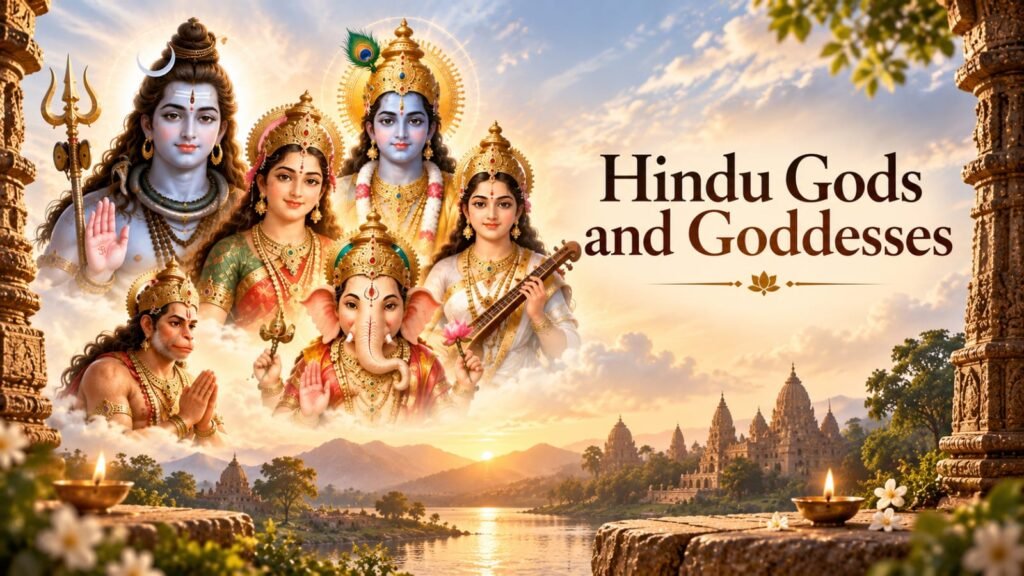
Hindu Gods and Goddesses
Many people love reading and hearing about Hindu Gods and Goddesses. Every family, every region, and every generation in India tells these stories a little differently. Some people learn them from grandparents. Some learn them from temple priests. Others read them in indian mythological novels and modern books. Because these stories are told so often, many people believe every detail comes straight from the old scriptures. But that is not always true.
This brings up an important question. Which parts of these stories come from the earliest, original scriptures? And which parts were added later by poets and storytellers? To answer this, we need to look closely at both the old texts and the many retellings that came after the.
What Do the Old Scriptures Really Say?
The base of ancient hindu mythology comes from a few key texts, the Vedas, the Puranas, and the two big epics, the Ramayana and the Mahabharata. These are the oldest sources, and they describe the gods and goddesses in a fairly simple and steady way. If you study ancient indian mythology, you will notice that these old texts do not usually give every small dramatic detail. They give the main story, like the birth, the purpose, and the powers of each god or goddess. They leave a lot of room for later storytellers to add more.
This is one reason why hindu mythology history has so many layers. One old text might describe a god’s story in just a few lines. Centuries later, poets and local storytellers added much more detail and drama to the same story. This is important to understand, because many things people believe today as fixed truth were actually added slowly, over hundreds of years, by many different people across India.
The Story of Shiva, Parvati, and Kali
One clear example of this is the story of the goddess Kali. In one popular version of the kali shiva story, Kali was born out of pure anger. She appeared when Goddess Durga was fighting a demon named Raktabija. Every drop of his blood that touched the ground turned into a new demon. So Kali drank his blood before it could fall, and this ended the fight.
But the story does not stop there. This is where the parvati shiva story becomes very meaningful. After the battle, Kali’s anger did not stop. She began a wild, powerful dance, and it threatened to shake the whole universe. According to the story, Shiva lay down in her path to calm her. When Kali’s foot touched her own husband, she suddenly felt shocked and shy, and she stopped. This scene is shown in a lot of Hindu art. It is one of the most famous images connected to any of the Hindu Gods and Goddesses. But different old texts and different regions tell this story in slightly different ways, so there is no single “correct” version.
Why the Same Story Changes From Region to Region
If you have heard hindu stories from more than one part of India, you may notice something interesting. The same god or goddess can be described very differently depending on where the story is told. A story about Kali from Bengal feels very different from the same story told in South India. A story about Ganesha from Maharashtra is different from how it is told in the mountains of North India.
This happens because hindu mythology culture grew over thousands of years through spoken word, not through one single book. Long before these stories were written down, people told them out loud, passing them from person to person. Each region added its own language, customs, and feelings to the story. This is why hindu mythology legends are not one single fixed set of stories. They are a large, living collection shaped by many communities, even though they all connect back to the same old scriptures.
From Old Palm Leaves to Modern Books
In recent years, many of these old stories have been printed as modern books. There are now many hindu mythology books that bring these ancient tales to readers who may never read the old Sanskrit texts. Some books are careful, accurate translations. Others are written more for fun and are closer to a simple hindu myths book, made to entertain people rather than to be an exact scholarly source.
There are also many indian mythological stories written especially for children, which explain the big ideas in easy language. Collections of indian mythological tales like these are often the first way young readers meet gods and goddesses, long before they read the original scriptures. For readers who prefer their own language, many hindi mythological stories are still shared today, both in books and by word of mouth. This keeps these stories alive as something people speak and share, not just something they read in English.
The Line Between Belief and Story
It helps to notice one important difference here. Hindu mythology beliefs are the values and lessons people take from these stories, like honesty, courage, or devotion. These beliefs are not always the exact same thing as every small detail in the story. A person can strongly believe in the lesson of a story without needing every dramatic detail to be historically exact.
This difference matters across all mythology hindu stories in Indian tradition, and it is the same reason many readers treat older hindu myth stories with a bit more care than newer, more decorative retellings. Big events from the Ramayana and Mahabharata are treated as important hindu epic stories with strong scriptural support. Other tales are more like folk hindu legends, loved for their lessons even though it is harder to trace exactly where they first came from.
The Characters Behind the Stories
At the center of all these tales are the gods and goddesses themselves. To really understand hindu mythology characters, it helps to look past the small details of each story and focus on what each god or goddess stands for. Shiva stands for destruction and change, working together with creation. Vishnu stands for protection and balance, and he appears on Earth in different forms whenever the world needs help. Devi, shown as Durga, Kali, Parvati, and others, stands for active power, called shakti, the force that moves the whole universe.
Once you understand what each god or goddess truly represents, a lot of hindu mythology explained in simple terms starts to make more sense. Even when the small details of a story change from place to place, the deeper meaning usually stays the same.
Why These Stories Still Matter Today
Hindu god stories have never just been for fun. They teach lessons, explain the world, and help people connect with big ideas through characters and events that are easy to remember. This is why hindu mythology stories have survived for thousands of years without losing their power. Every generation finds something new and useful in stories that are actually very old.
Whether you hear these stories from a grandparent, read them in a children’s book, or study them seriously as part of ancient hindu mythology, they still teach us about courage, love, fairness, and change, ideas that still feel important today, even though the stories are thousands of years old.
Conclusion: Old Scripture and Living Tradition
The world of Hindu Gods and Goddesses is much bigger than any single story can show. The oldest scriptures give the basic shape of each god’s character and purpose. Over time, storytellers, poets, and regional traditions added rich, emotional details that many people now think are part of the original text. Knowing the difference between what the old scriptures actually say and what came later does not make these stories less special. In fact, it helps us respect just how much creativity and devotion people have put into these stories for thousands of years.
Frequently Asked Questions
What is the difference between Hindu scripture and Hindu mythology? Scripture means the original old texts, like the Vedas, Puranas, and the two epics. Mythology includes all the extra stories, folklore, and different versions that grew around those old texts over time.
Do all stories about Hindu Gods and Goddesses come from the original scriptures? No. Many popular details come from later stories, folk tales, and regional retellings, not from the earliest scriptures, even though people often think they are the same.
Why do the same stories change from place to place in India? Because these stories were first told out loud, long before they were written down. As they passed from person to person, each region added its own language and style.
Is Kali the same as Parvati? Different texts answer this differently. Some say Kali is a fierce form of Parvati or Durga. Others treat her as a separate goddess. This is one reason her story changes so much between regions.
Why are there so many books about these stories today? Modern printing has made these old stories easy to find. Some books stay close to the original text, while others are written mainly to entertain. This helps more people learn these stories, even without reading the original Sanskrit texts.
What is the main purpose of these stories? Beyond entertainment, these stories help explain big ideas like duty, sacrifice, and balance in the world, using gods and goddesses as characters people can easily understand and remember.