
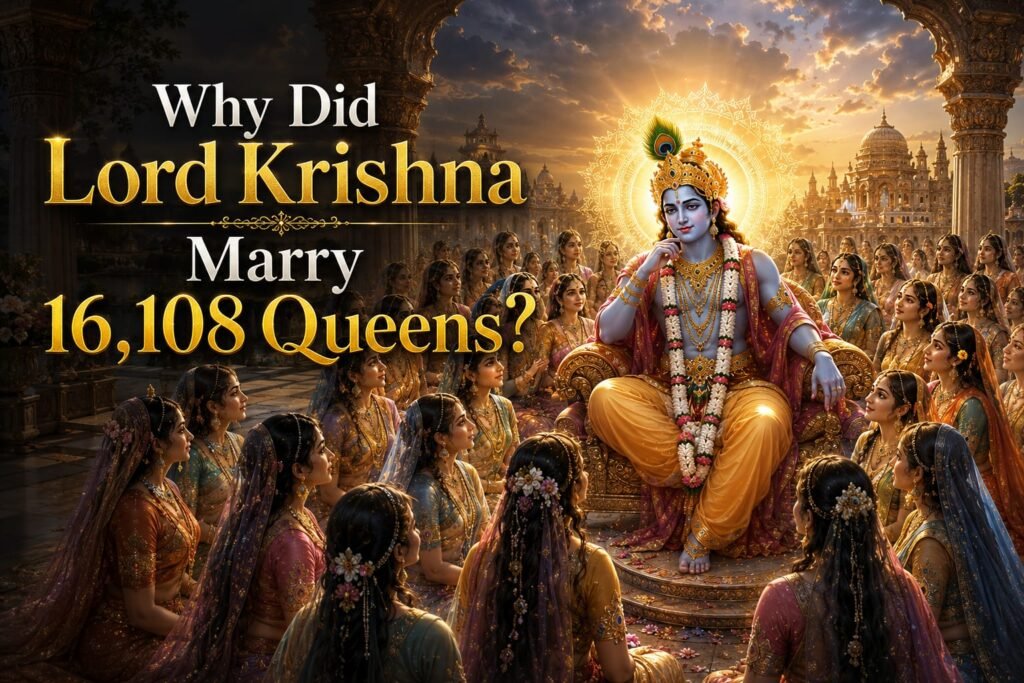
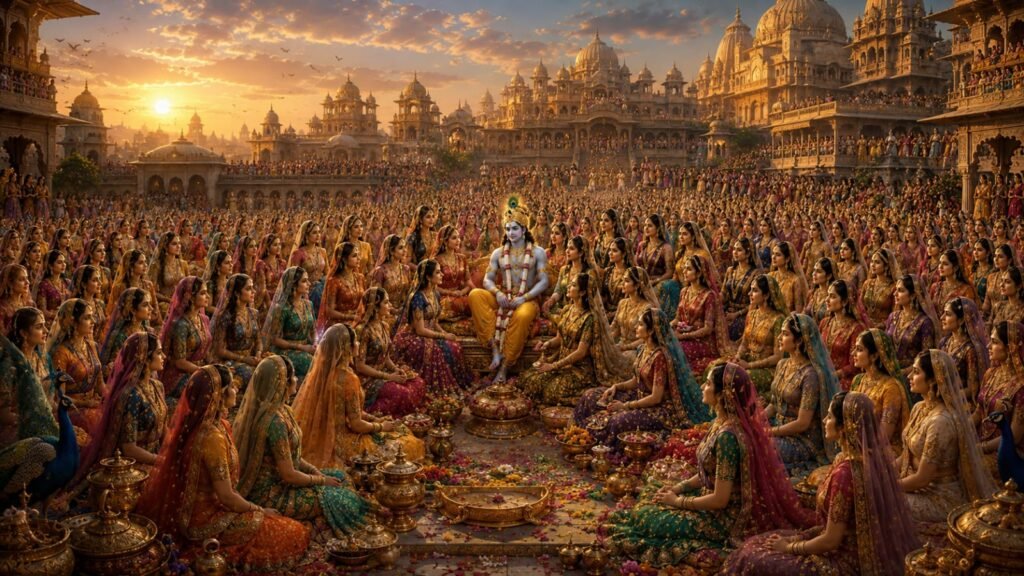
At first glance, one of the most surprising facts about Lord Krishna’s life is the claim that he married 16,108 queens. To many modern readers, this number seems impossible, and it often raises questions about what it actually means. Some treat it purely as a symbolic story, while others wonder whether it reflects historical memory dressed in the language of scripture. Either way, this detail has become one of the most misunderstood parts of Krishna’s entire life story.
The fuller answer, found across the Bhagavata Purana, Vishnu Purana, and Harivamsha, is far more layered than the number suggests on its own. Krishna did not marry thousands of women out of personal desire or royal ambition. According to these texts, his marriages were tied closely to compassion, social responsibility, and the restoration of dignity to women who had suffered a profound injustice. Understanding the real story means looking past the figure of 16,108 itself and examining exactly who these queens were and what circumstances brought each group into his life.
It also helps to understand from the outset that this number does not describe a single event. According to Hindu scriptures, the total combines Krishna’s eight principal queens, collectively known as the Ashtabharya, with 16,100 princesses he later rescued from the captivity of the demon king Narakasura. Keeping these two groups distinct is essential, since the reasons behind each set of marriages are entirely different, and conflating them is where much of the modern confusion around this story tends to begin.
Krishna’s Eight Principal Queens
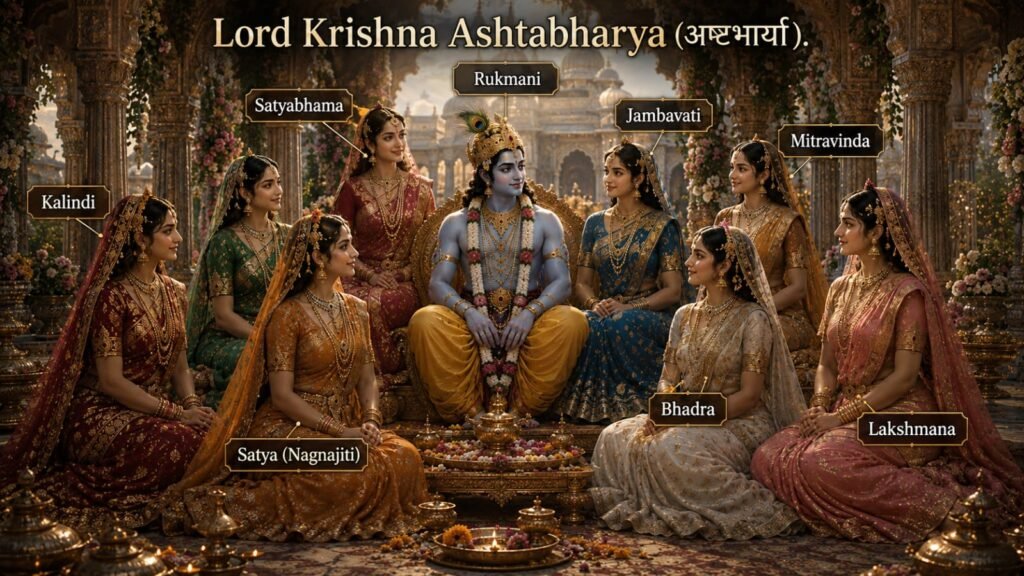
Although Krishna is associated with the much larger figure of 16,108 queens, Hindu scriptures first identify eight principal queens known collectively as the Ashtabharya. These queens held a distinct and honored place within Krishna’s household, and unlike the marriages that came later, each of their unions arose through separate and very different circumstances, shaped by royal custom, personal choice, and, in some cases, acts of heroism.
The eight principal queens were Rukmini, Satyabhama, Jambavati, Kalindi, Mitravinda, Nagnajiti, also known as Satya, Bhadra, and Lakshmana. Their stories appear across the Bhagavata Purana, Harivamsha, and Vishnu Purana, and no two marriages followed quite the same path. Jambavati, for instance, became his wife after Krishna defeated her father, the bear king Jambavan, during the well known episode involving the Syamantaka gem, while other unions, such as his marriage to Rukmini, took place through a Swayamvara in which the princess herself chose Krishna as her husband against her family’s wishes. This variety matters, since it shows that Krishna’s principal marriages were shaped by individual events rather than a single repeated pattern.
These eight queens went on to hold significant standing in Krishna’s household and in the affairs of Dwarka, appearing frequently throughout the Puranas as respected figures in their own right rather than passive background characters. Understanding their place clearly is important precisely because it separates these royal marriages, each rooted in its own distinct story, from the very different circumstances that would later bring the remaining 16,100 princesses into Krishna’s life.
The Story of Narakasura and the Captive Princesses
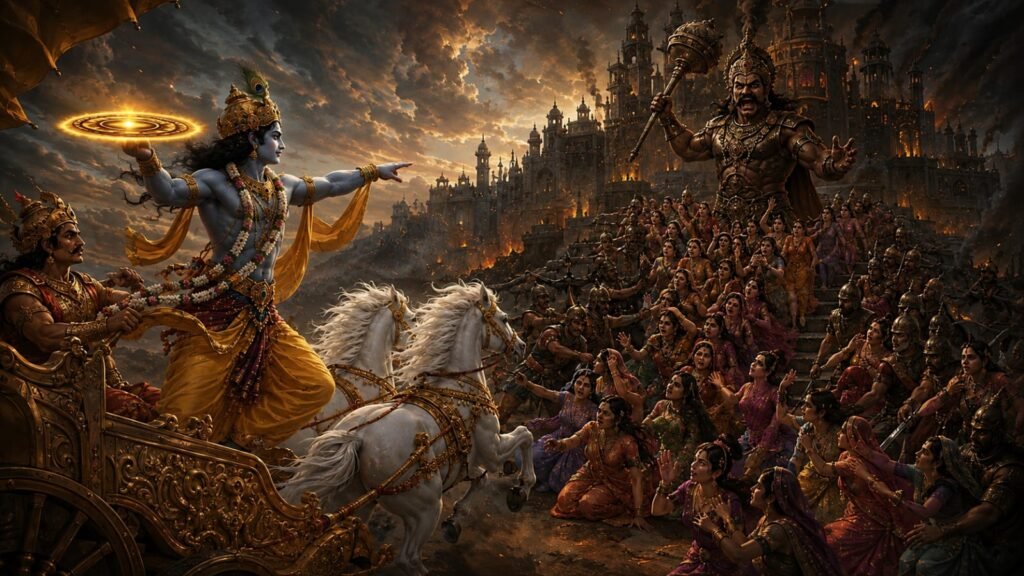
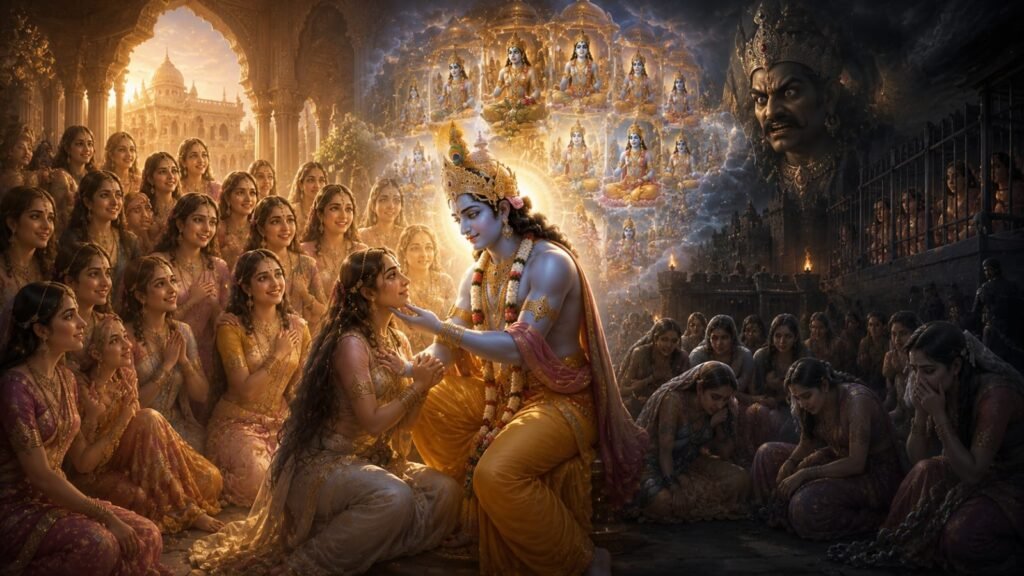
The turning point in this larger story came with the rise of Narakasura, a powerful demon king who ruled the ancient kingdom of Pragjyotisha. According to the Bhagavata Purana’s tenth canto, Narakasura had waged war against numerous smaller kingdoms, defeating their rulers and abducting sixteen thousand one hundred royal princesses in the process. These women were held against their will inside his heavily fortified palace, with little realistic hope of ever returning home to their families.
Determined to put an end to Narakasura’s tyranny, Krishna, accompanied by his queen Satyabhama, marched against the demon king’s stronghold. After a fierce and decisive battle, Krishna defeated Narakasura and freed all sixteen thousand one hundred captive princesses from imprisonment. His victory brought an end to years of suffering across the kingdoms Narakasura had terrorized, but for the newly freed women themselves, liberation brought an unexpected and deeply personal challenge of its own.
Although the princesses had done nothing wrong and had been taken entirely against their will, they feared that the wider society of the time would not see it that way. Returning home did not guarantee that their families or communities would welcome them back without suspicion, and many believed no king would agree to marry them given where they had been held captive. According to the Bhagavata Purana, the princesses themselves approached Krishna and asked him directly to accept them, believing he alone held the standing to restore the dignity that captivity had stripped from them. This request became the foundation for one of the most widely misunderstood episodes in his entire story, one that only makes sense once the social realities behind it are properly understood.
Why Krishna Chose to Marry the Rescued Princesses
After their release from Narakasura’s palace, the sixteen thousand one hundred princesses found themselves facing an almost impossible situation. Even though they had been abducted through no fault of their own, ancient royal custom often treated women who had lived under another ruler’s control with suspicion regardless of the circumstances. According to the Bhagavata Purana, the princesses pleaded directly with Krishna not to leave them without protection, explaining plainly that neither their own families nor any other ruling household was likely to accept them back into normal society.
Moved by their situation, Krishna chose to marry all of them. The scriptures are careful to frame this decision not as an act of personal desire, but as one rooted in protection, dignity, and social restoration. By accepting the princesses as his wives, Krishna ensured that each of them regained the honor and standing that Narakasura’s actions had taken from them, offering security and recognition within his own household rather than leaving them to face rejection and humiliation on their own.
This choice also reflected something central to how Krishna’s actions are remembered throughout Hindu tradition, his consistent alignment with dharma over personal convenience. Rescuing the princesses from captivity alone would not have restored their place in society, and Krishna is described understanding this clearly. By marrying them, he removed the social stigma attached to their captivity and gave each woman a respected position rather than a life spent explaining circumstances that had never been her fault to begin with. For this reason, Hindu scriptures remember these marriages as acts of compassion and responsibility rather than personal ambition or excess.
How Could Krishna Live with 16,108 Queens?
One of the most common questions people ask about this story is a fairly practical one, how could any single person possibly live with 16,108 queens at once. The Bhagavata Purana answers this not through ordinary logistics, but by pointing directly to Krishna’s identity as an avatar of Vishnu, someone not bound by the same limitations that shape ordinary human life. According to the text, Krishna expanded himself into 16,108 identical forms, with each form residing in its own separate palace and spending genuine, individual time with each queen.
This claim is illustrated through the well known episode involving the sage Narada, who is described visiting Dwarka specifically to witness this phenomenon for himself. Expecting to find Krishna present in only one location at a time, Narada instead discovered him simultaneously active in every single palace, engaged in entirely different activities with each queen at once. This episode is frequently cited in devotional teaching as clear evidence of Krishna’s divine nature, reinforcing the belief that the Supreme Being, unlike an ordinary king, is capable of being fully and completely present with every devotee at the same moment, rather than dividing limited attention among many.
The Spiritual Meaning Behind the 16,108 Marriages
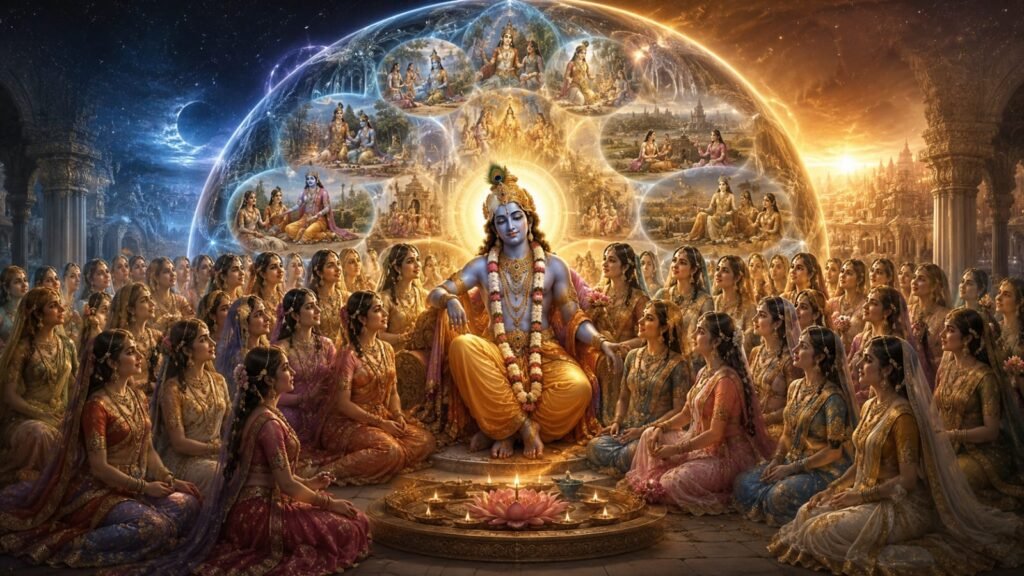
Beyond the historical account itself, many devotional traditions read Krishna’s marriages as carrying a deeper symbolic meaning that extends well past the specific events involving Narakasura. The rescued queens are often interpreted as representing countless individual souls who turn to the divine for refuge after enduring suffering, fear, or separation of their own. Krishna’s willingness to accept every single princess, without exception or hesitation, is read by many as a symbol that no sincere devotee is ever turned away, regardless of what hardship they may have already endured.
This spiritual interpretation does not replace the scriptural narrative so much as sit alongside it. While the Bhagavata Purana records the historical events surrounding Narakasura and the rescue of the princesses as an actual episode within Krishna’s life, devotional tradition layers an additional meaning on top of it, emphasizing that Krishna’s compassion extends equally to anyone who sincerely seeks him, not only to those with a dramatic backstory. Read this way, his marriages become a lasting symbol of divine grace and unconditional acceptance rather than simply a chapter of royal history.
For many devotees, this episode is remembered specifically because of what it reveals about Krishna’s character rather than the scale of the event itself, his willingness to protect and honor those whom the rest of society had already written off. Rather than judging the princesses for circumstances entirely outside their control, he restored their dignity and offered them a genuine new beginning. This message continues to resonate well beyond its original context, often cited as a reminder that real compassion means uplifting others without prejudice, not simply offering sympathy from a distance.
Did Krishna Marry 16,108 Women Out of Desire?
One of the most persistent misconceptions surrounding this story is the idea that Krishna married thousands of women purely out of personal desire or the luxury available to him as a king. The primary scriptures do not support this reading. The Bhagavata Purana, Vishnu Purana, and Harivamsha consistently frame Krishna’s marriages as acts connected to dharma, responsibility, and compassion, rather than personal indulgence or excess.
His eight principal queens were married through entirely separate scriptural events, each shaped by its own particular story, while the remaining 16,100 marriages followed directly from the rescue of the captive princesses from Narakasura’s prison. Taken together, these two very different sets of events present Krishna not as a ruler pursuing a vast personal harem, but as a protector who restored dignity, honor, and security to women who had already suffered a serious injustice through no fault of their own.
Understood this way, the story ultimately teaches that Krishna’s actions were guided by righteousness rather than personal appetite. Rather than pursuing power or pleasure for its own sake, he chose to uphold justice, defend the innocent, and restore the lives of women who otherwise had nowhere else to turn. Read in its full scriptural context, the story of Krishna’s 16,108 queens becomes a striking example of compassion, responsibility, and quiet leadership rather than a tale of excess.
Conclusion: Understanding the True Meaning Behind Krishna’s 16,108 Marriages
The story of Lord Krishna’s 16,108 queens is often misunderstood when it is read only through the lens of the number itself. Hindu scriptures present a far deeper account underneath it. While his eight principal queens became his wives through separate royal and personal events, the remaining 16,100 princesses were women rescued from the captivity of Narakasura, and by marrying them, Krishna restored their honor, protected them from social rejection, and fulfilled his role as an upholder of dharma rather than simply expanding his own household.
The Bhagavata Purana, Vishnu Purana, and Harivamsha consistently present these marriages as acts of compassion, responsibility, and protection rather than personal desire, and Krishna’s ability to appear simultaneously across thousands of palaces further reinforces his identity as the Supreme Being, someone whose actions cannot be measured solely by ordinary human standards or assumptions.
Ultimately, this episode is remembered because it reflects a purpose far larger than the number attached to it, offering refuge to those in need and restoring dignity to the innocent. Read in its proper scriptural context, the story of Krishna’s 16,108 queens becomes not a tale of excess, but one of honor, protection, and a compassion that made no exceptions for who deserved to receive it.
Frequently Asked Questions
Why did Lord Krishna marry 16,108 queens?
According to the Bhagavata Purana, Krishna married 16,100 princesses after rescuing them from the captivity of the demon king Narakasura, since society was unlikely to accept them after their imprisonment, and he married them to restore their honor and dignity. Along with his eight principal queens, the Ashtabharya, this brought the total to 16,108 queens.
Who were Krishna’s eight principal queens?
Krishna’s eight principal queens were Rukmini, Satyabhama, Jambavati, Kalindi, Mitravinda, Nagnajiti, also known as Satya, Bhadra, and Lakshmana. Collectively known as the Ashtabharya, their marriages are described across the Bhagavata Purana, Vishnu Purana, and Harivamsha.
Who was Narakasura?
Narakasura was a powerful demon king who ruled the ancient kingdom of Pragjyotisha. According to the Bhagavata Purana, he imprisoned 16,100 royal princesses after conquering several kingdoms, and Krishna later defeated him in battle and freed the captive women.
How could Krishna live with 16,108 queens?
The Bhagavata Purana explains that Krishna expanded himself into 16,108 divine forms, allowing him to reside in separate palaces and spend genuine time with each queen simultaneously, a miracle witnessed firsthand by the sage Narada during a visit to Dwarka.
Did Krishna marry all the queens out of love or desire?
The scriptures do not describe these marriages as acts of personal desire. Krishna married the rescued princesses specifically to restore their dignity, protect them from social rejection, and uphold dharma following their captivity under Narakasura.
Are Krishna’s 16,108 marriages meant to be read symbolically?
The primary scriptures present these marriages as historical events within the narrative of Krishna’s life. Many devotional traditions also read them symbolically, viewing the queens as representing countless souls who seek refuge in the divine after hardship.
Which scriptures mention Krishna’s 16,108 queens?
This story appears primarily in the tenth canto of the Bhagavata Purana, with supporting accounts found in the Vishnu Purana and the Harivamsha.
What lesson does the story of Krishna’s marriages teach?
The story demonstrates that true leadership is rooted in compassion and responsibility rather than personal gain. After rescuing the princesses from captivity, Krishna also restored their honor and secured their future, showing that protecting the vulnerable is an essential part of upholding dharma.