
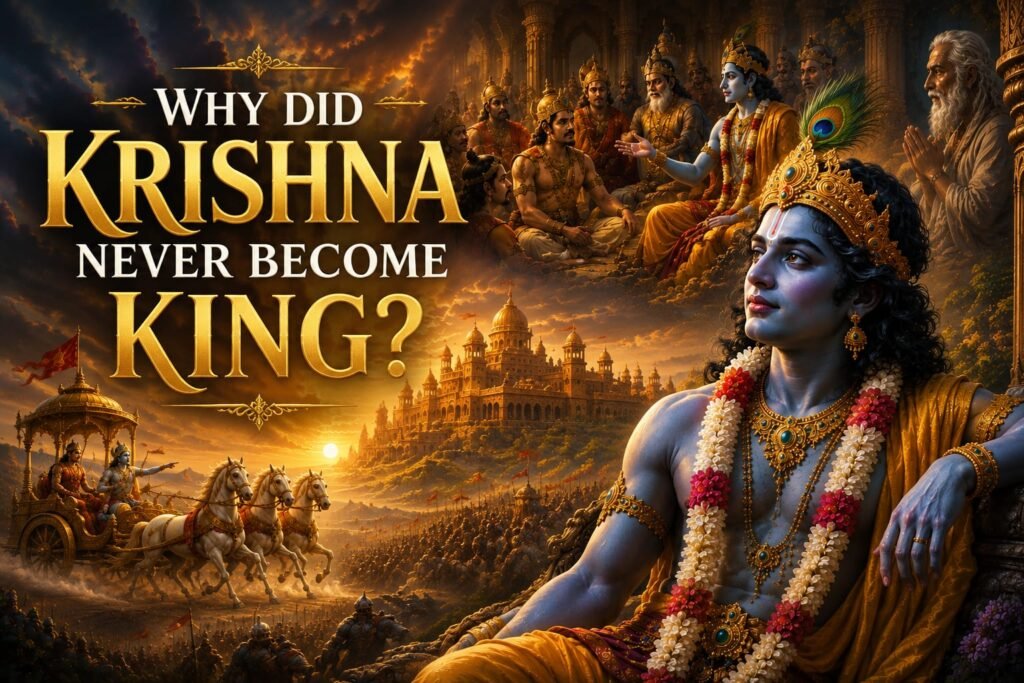
Krishna was born into a royal lineage, destined by prophecy to bring down a tyrant, and yet he never sat on a throne of his own making in the way many expect of a king in mythology. This detail surprises many people encountering his story for the first time, since Krishna is remembered as one of the most powerful and politically influential figures in the entire Mahabharata, someone whose word could shape the fate of kingdoms, and yet who never wore a crown himself. Understanding why did Krishna never become king reveals something important about how Hindu tradition separates power from position, and influence from title.
This distinction becomes even more striking when Krishna is compared to other major figures in the same epic, many of whom fought wars, made alliances, and endured long exile specifically to reclaim or secure a throne. Krishna, by contrast, is shown deliberately stepping back from kingship at more than one point in his life, even when circumstances would have made claiming it easy or expected. This pattern is not treated as incidental in the Puranas and the Mahabharata, but as a defining feature of his character, one that reveals how differently Krishna’s story approaches the idea of royal authority compared to almost every other figure around him.
Born a Prince Yet Raised Far From the Palace
According to the Bhagavata Purana and the Vishnu Purana, Krishna was born in Mathura to Devaki and Vasudeva, making him a prince by direct royal bloodline. However, his birth came with immediate danger, since a prophecy had warned that Devaki’s eighth son would be responsible for the death of her tyrannical brother, King Kansa. To protect the infant, Vasudeva carried Krishna across the Yamuna river on the night of his birth and left him in the care of Nanda and Yashoda in Gokul, far from the palace where he was technically entitled to grow up.
This early separation from royal life shaped the entire trajectory of Krishna’s story. Rather than being raised amid court politics and the expectations of succession, he grew up among cowherds, spending his childhood herding cattle, playing with village children, and becoming known through simple, intimate stories rather than any display of royal privilege. Ancient texts describe this period as essential to how Krishna’s character developed, since his connection to ordinary people and rural life remained a defining part of his identity even after his royal origins were later revealed and widely known.
The Killing of Kansa and the Throne That Followed
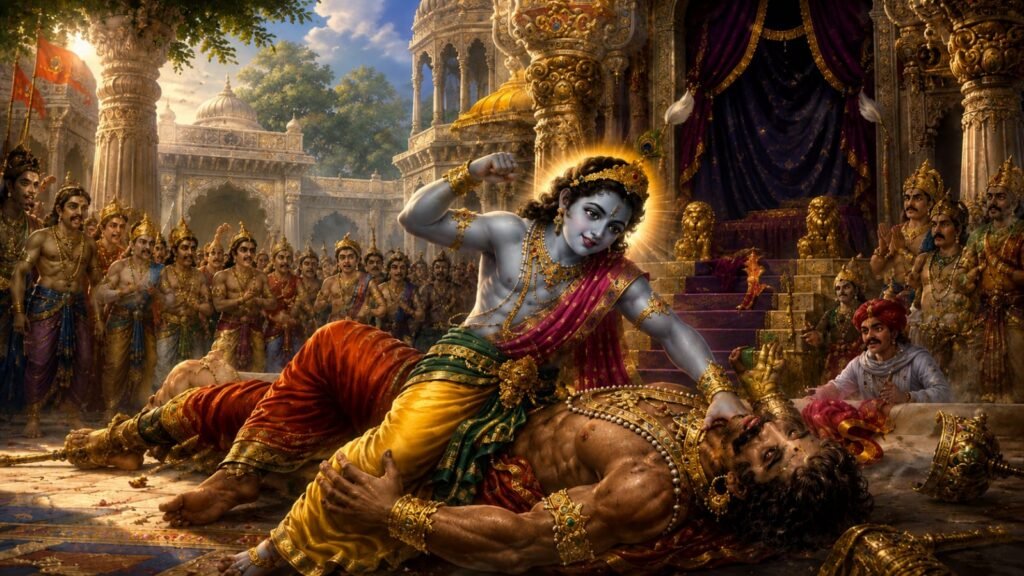
Krishna’s return to Mathura as a young man is one of the most pivotal moments in his story. According to the Puranas, he entered the city, confronted Kansa directly, and killed him in single combat, fulfilling the prophecy that had shaped his entire early life and freeing Mathura from years of tyranny. This moment placed Krishna in a position where claiming the throne would have been not only possible but expected, since he had personally removed the very ruler who had occupied it.
Instead of taking the crown for himself, Krishna chose to restore the throne to his grandfather, Ugrasena, who had originally been imprisoned and overthrown by Kansa. According to tradition, Krishna framed this decision as a matter of rightful restoration rather than personal ambition, correcting the injustice done to Ugrasena rather than replacing one ruler with another of his own choosing. This single decision set the tone for how Krishna would approach questions of power throughout the rest of his life, treating kingship as something to be restored to its rightful holder rather than claimed by whoever held the most influence at the moment.
It is worth noting that Krishna was still very young at the time of this event, having only recently left the pastoral world of Gokul and Vrindavan behind. Many retellings emphasize this contrast deliberately, showing a young man who had just stepped into the political center of a major kingdom choosing restraint over ambition at the very first opportunity to claim power for himself. This early test of character is often treated as foundational to everything that follows in his story, establishing a pattern of behavior long before the far more complex political events of the Mahabharata placed him at the center of an even larger conflict.
Why Restoring Ugrasena Mattered More Than Claiming Power
This decision is often highlighted in devotional teaching as one of the clearest early examples of Krishna acting according to dharma rather than self interest. Many scholars believe this moment was deliberately included in the Puranas to establish Krishna’s character before the more complex political events of the Mahabharata, showing readers early on that his actions would consistently prioritize what was right over what was personally advantageous.
By restoring Ugrasena rather than ruling in his place, Krishna also avoided placing himself at the center of a succession dispute within his own family, since multiple members of the Yadava clan held legitimate claims and interests in Mathura’s throne. According to several interpretations, this choice reflected a broader political wisdom on Krishna’s part, understanding that stability within the Yadava community depended on honoring existing claims rather than asserting a new one, even one that would have been easy to justify given his role in defeating Kansa.
The Founding of Dwarka and a New Kind of Leadership
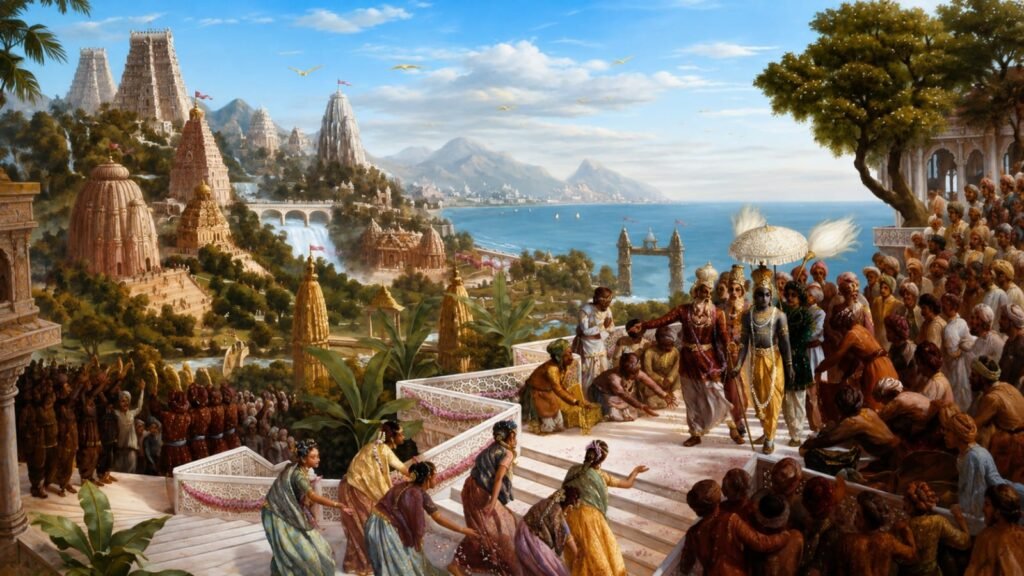
Krishna’s story does not end with his return of the throne in Mathura. According to the Puranas, ongoing conflict with Jarasandha, a powerful king allied to Kansa by marriage, eventually forced the Yadavas to leave Mathura entirely and establish a new settlement in Dwarka, a coastal city built specifically to protect the community from repeated invasion. This relocation marked another point where Krishna’s leadership shaped the fate of his people without necessarily requiring him to hold the formal title of king.
Accounts differ on the exact nature of governance in Dwarka, and this interpretation varies across texts and regional traditions. Some descriptions present Krishna as the central guiding figure of the city in practice, while formal or ceremonial kingship is associated with other members of the Yadava lineage, continuing the same pattern established back in Mathura. Other traditions describe Krishna’s role in Dwarka in more directly royal terms, though even these accounts consistently emphasize his role as protector and unifier of the Yadava clan over any personal claim to expanding his own power or territory.
Krishna’s Role in the Mahabharata Without a Throne of His Own
Perhaps the clearest demonstration of Krishna’s relationship to power comes from his role in the Mahabharata itself, where he holds no throne yet influences the outcome of the entire war more than almost any king involved in it. According to the epic, Krishna served as charioteer and advisor to Arjuna, offering counsel that shaped major decisions on the battlefield, most famously through the teachings later compiled as the Bhagavad Gita.
This role placed Krishna in a position of enormous influence without any of the formal authority typically associated with kingship, since he directed strategy, offered moral guidance, and shaped the course of the war entirely through wisdom and relationship rather than command backed by a throne. Many scholars believe this arrangement was central to how the Mahabharata portrays ideal leadership, suggesting that true influence in Hindu tradition is not always tied to holding formal power, but can instead come from clarity of purpose and trusted counsel offered at the right moment.
Krishna’s Peace Mission to Hastinapura and the Limits of His Influence
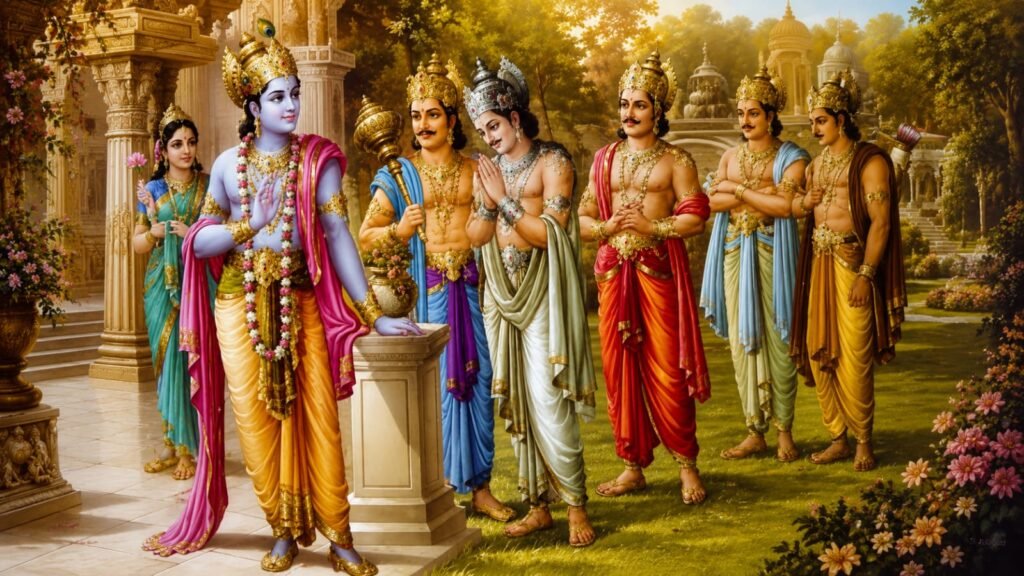
Before the war at Kurukshetra even began, Krishna is described in the Mahabharata as traveling to Hastinapura as a peace envoy on behalf of the Pandavas, attempting to negotiate a settlement that would avoid armed conflict altogether. According to the epic, he appeared before the full royal assembly, presented reasonable terms on behalf of Yudhishthira, and appealed directly to Duryodhana’s sense of duty and fairness, all without holding any official diplomatic title or royal authority of his own beyond his standing as an ally and kinsman of the Pandavas.
This mission ultimately failed, since Duryodhana refused every proposal, even the request for only five villages in place of the Pandavas’ full share of the kingdom. What stands out in this episode, according to many retellings, is that Krishna’s authority in the assembly came entirely from the respect and fear he commanded as an individual, not from any position of rulership that could compel Duryodhana to listen. This moment is often cited as clear evidence that Krishna operated as a moral and political force in his own right, someone whose influence did not depend on, and was not increased by, holding a throne of his own.
The episode also reveals an important limit to Krishna’s influence, since even his considerable standing could not force a resolution when the other party refused to act in good faith. Rather than resorting to unilateral action or attempting to seize control of the negotiation through force, Krishna is described as accepting the failure of the mission and returning to prepare for the war that had by then become unavoidable. Many scholars believe this restraint, even in the face of Duryodhana’s refusal, further reinforces how consistently Krishna avoided positioning himself as a ruler with the authority to simply impose an outcome.
Krishna’s Later Years and the End of the Yadava Line Without a Throne
According to the Mausala Parva of the Mahabharata, the final years of Lord Krishna’s life were marked by the destruction of the Yadava clan through a combination of divine curses, internal conflict, and the unfolding of destiny. The immediate chain of events began after Samba, Krishna’s son, and other Yadava princes mocked a group of revered sages, who cursed that an iron mace would bring about the destruction of their entire clan. Although the Yadavas attempted to destroy the cursed weapon, the prophecy was ultimately fulfilled during a violent conflict among themselves. Even during this period, the scriptures do not describe Krishna attempting to claim the throne or establish himself as the formal ruler of the Yadavas, remaining consistent with the role of a guide and protector rather than a king throughout his life.
Krishna’s earthly life came to an end in a forest near Prabhasa after he was accidentally struck by an arrow fired by the hunter Jara, as narrated in both the Mahabharata and the Shrimad Bhagavata Purana. His departure is described without any transfer of a royal throne or the continuation of a dynasty founded upon his personal rule. Instead, these scriptures portray Krishna’s mission as the restoration of dharma and the protection of righteousness during a critical period, rather than the establishment of a lasting earthly kingdom under his own kingship.
What Krishna’s Avoidance of Kingship Reveals About His Purpose
Beyond these individual episodes, Krishna’s consistent avoidance of formal kingship reflects a broader theme found throughout his story as an avatar of Vishnu. According to Hindu tradition, Krishna’s incarnation was meant to restore dharma and support righteousness during a period of moral decline, a purpose that required flexibility, influence, and moral clarity far more than it required control over a specific territory or title.
This distinction between power and position also aligns closely with the teachings Krishna himself delivers in the Bhagavad Gita, where he repeatedly emphasizes performing one’s duty without attachment to personal reward or status. Many scholars believe that Krishna’s own life, marked by his repeated stepping back from thrones he could easily have claimed, serves as a living demonstration of this same teaching, showing through action what he later explains through philosophy to Arjuna on the battlefield of Kurukshetra.
Viewed this way, Krishna’s entire life can be read as a kind of teaching delivered through example long before it was ever delivered through words. Every decision to step back from a throne, from Mathura to Dwarka, appears less like a series of unrelated choices and more like a consistent demonstration of the very philosophy he would later articulate directly. This coherence between action and teaching is often cited by scholars as one of the reasons Krishna’s character carries such lasting weight in Hindu tradition, since his wisdom is not presented as abstract theory but as something he had already lived out fully by the time he chose to put it into words.
How This Pattern Sets Krishna Apart From Other Epic Heroes
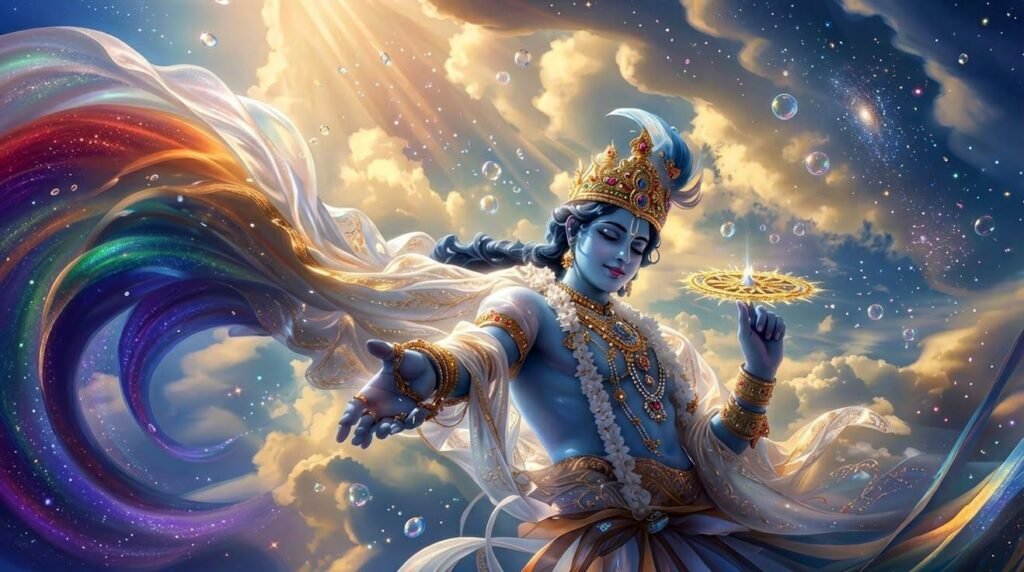
When compared with other major figures across the Mahabharata and Ramayana, Krishna’s relationship to kingship stands out as distinctly unusual. Figures like Yudhishthira spend years in exile specifically working to reclaim a throne they consider rightfully theirs, while Rama’s story in the Ramayana centers heavily around his eventual return to Ayodhya to take up the crown that was originally meant for him. Krishna’s story moves in the opposite direction at nearly every turn, consistently placing him in positions of influence while deliberately avoiding formal rulership.
This contrast is often used in devotional and scholarly discussion to highlight the range of ways Hindu mythology imagines ideal leadership, showing that righteous action does not always look the same across different avatars or heroes. Where Rama’s dharma is closely tied to fulfilling his role as a rightful king, Krishna’s dharma is shown through his willingness to guide, protect, and advise without needing the throne itself to validate his purpose, offering a different but equally respected model of what committed, principled leadership can look like.
Frequently Asked Questions
Why did Krishna never become king of Mathura?
After killing Kansa, Krishna restored the throne of Mathura to his grandfather Ugrasena instead of ruling himself. According to tradition, this reflected his priority of correcting an injustice rather than claiming power, setting a pattern of avoiding personal rulership that continued throughout his life.
Did Krishna ever rule as king anywhere?
Accounts vary across texts and regional traditions. Some descriptions present Krishna as the central guiding figure of Dwarka in practice, while formal kingship is associated with other members of the Yadava lineage. Other traditions describe his role in more directly royal terms, though his image as protector and unifier remains consistent across most versions.
Why did Krishna give the throne back to Ugrasena instead of keeping it?
According to the Puranas, Ugrasena was the rightful ruler before being overthrown by Kansa. Krishna framed his actions as restoring justice rather than replacing one ruler with another, avoiding a succession dispute within the Yadava clan and reinforcing his consistent preference for dharma over personal gain.
What role did Krishna play in the Mahabharata if he was not a king?
Krishna served as Arjuna’s charioteer and advisor during the Mahabharata war, offering the guidance later compiled as the Bhagavad Gita. His influence over the war’s outcome came through wisdom and counsel rather than any formal throne or army of his own command.
How does Krishna’s avoidance of kingship connect to his role as an avatar?
According to Hindu tradition, Krishna’s incarnation as an avatar of Vishnu was meant to restore dharma during a period of moral decline. This purpose required flexibility and moral clarity more than control over a specific territory, which many scholars believe explains his consistent preference for influence over formal rulership.
How is Krishna’s relationship to kingship different from Rama’s in the Ramayana?
Rama’s story centers heavily around reclaiming and taking up the throne of Ayodhya as part of fulfilling his dharma. Krishna’s story moves in the opposite direction, repeatedly placing him in positions of influence while avoiding formal rulership, showing a different but equally respected model of righteous leadership within Hindu tradition.
Why is this aspect of Krishna’s story significant in Hindu teaching?
Krishna’s repeated avoidance of kingship is often used in devotional and scholarly teaching to illustrate that true leadership and dharma are not always tied to holding formal power or title. This theme connects directly to his own teachings in the Bhagavad Gita about performing duty without attachment to personal reward or status.
Conclusion: A Meaningful Takeaway
Krishna’s story challenges a common assumption in mythology, that a hero born into royalty must eventually claim a throne to fulfill his destiny. Instead, Hindu tradition presents a figure who repeatedly chooses influence over authority, restoration over conquest, and guidance over command, reshaping what leadership can look like within the epic imagination. His path suggests that real purpose is not always measured by the position one holds, but by the clarity and integrity with which one acts, regardless of whether a crown is ever part of the picture.
This idea continues to resonate well beyond the world of scripture, offering a quiet but enduring lesson for anyone who measures their own worth by title or position rather than by the impact of their actions. Krishna’s example, chosen again and again throughout his life, suggests that the most meaningful kind of leadership often has little to do with sitting on a throne, and everything to do with showing up with wisdom and integrity when it matters most.