
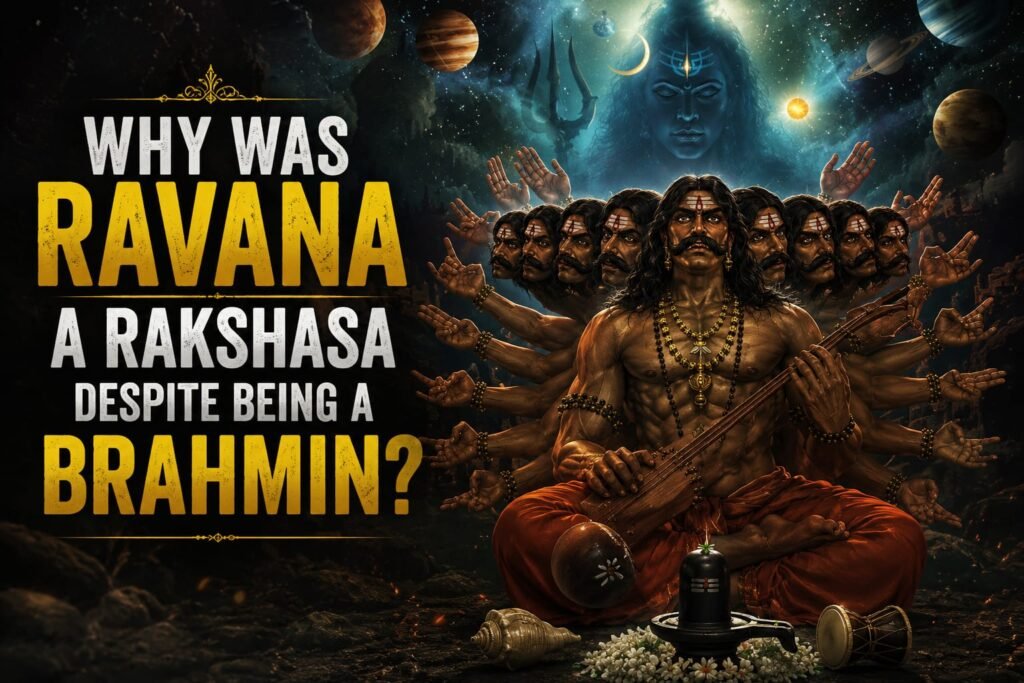
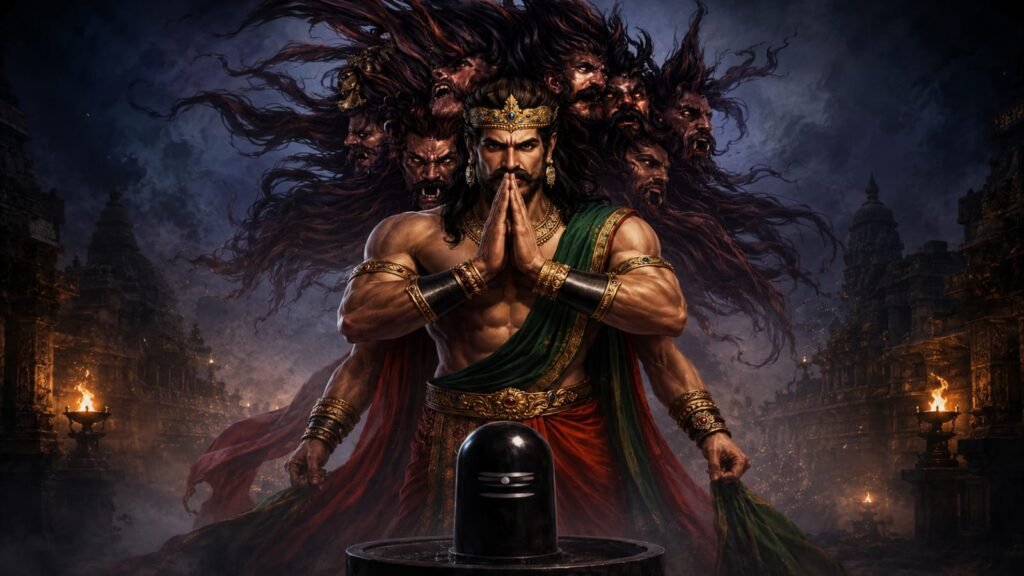
One of the most frequently asked questions about the Ramayana is how Ravana could be described as both a Brahmin and a Rakshasa at the same time. At first glance, these two identities seem genuinely contradictory to many readers. Since Brahmins are traditionally associated with learning, spirituality, and Vedic knowledge, it can seem strange that one of Hindu mythology’s most powerful Rakshasa kings was born into a Brahmin family in the first place.
Much of this confusion comes from treating the terms Brahmin and Rakshasa as though they describe the same kind of identity, when in Hindu scripture they actually refer to different aspects of a person’s background entirely. Brahmin relates to lineage, learning, and priestly heritage passed down through the paternal line, while Rakshasa can refer to ancestry through the maternal line, the community or kingdom a person belongs to, or simply the nature and conduct they display throughout their life. According to the Valmiki Ramayana, the Vishnu Purana, and several other Hindu texts, Ravana’s identity was shaped by both sides of his family in exactly this way, and understanding his father, his mother, and the household he was born into goes a long way toward explaining why the scriptures consistently describe him as a Brahmin by birth and a Rakshasa king by heritage and by the life he chose to live.
Ravana’s Father Was a Brahmin Sage
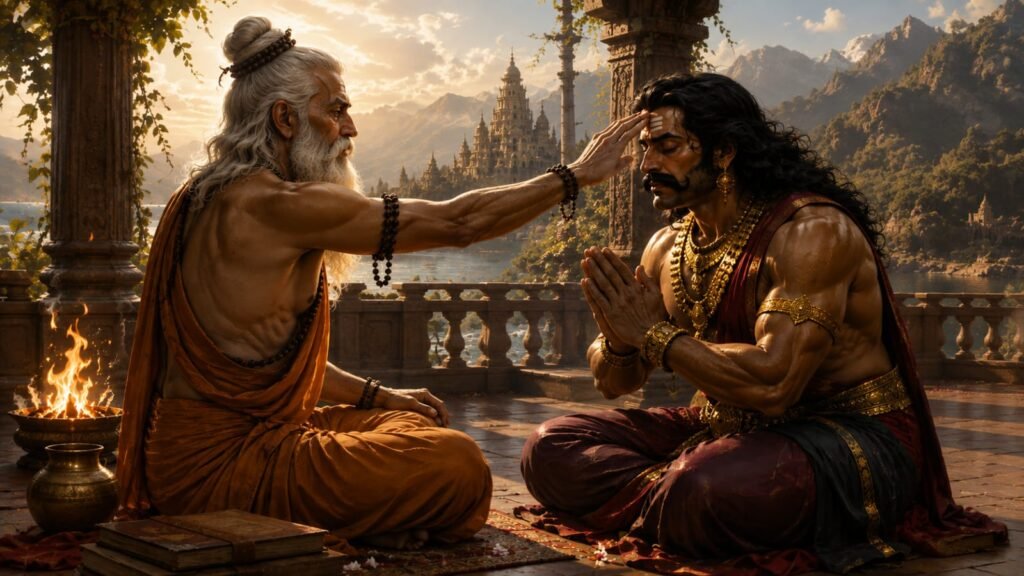
According to the Valmiki Ramayana, Ravana’s father was Sage Vishrava, a highly respected Brahmin sage renowned throughout the tradition for his deep knowledge of the Vedas and his spiritual wisdom. Vishrava himself was the son of Sage Pulastya, one of the Saptarishis, the Seven Great Sages, and a mind-born son, a Manasaputra, of Lord Brahma. This placed Ravana firmly within one of the most distinguished Brahmin lineages described anywhere in Hindu tradition, a heritage stretching back directly to Brahma himself.
Growing up under his father’s guidance, Ravana is described receiving an exceptional education from a very young age. The scriptures present him as a brilliant scholar who mastered the Vedas thoroughly, became an expert in astrology, music, statecraft, and the use of powerful divine weapons in equal measure. This depth of learning is part of why later tradition remembers him not simply as a mighty warrior, but as a genuinely learned king in his own right, someone whose intellect was never in serious doubt even among his enemies.
Because of this paternal lineage, Ravana is widely acknowledged across Hindu tradition as having been born into a Brahmin family in the fullest sense. This particular aspect of his identity is reflected consistently throughout both the Ramayana and the Puranas, which openly recognize his scholarly abilities and his descent from one of the greatest sage families found anywhere in Hindu mythology.
Ravana’s Mother Belonged to the Rakshasa Lineage
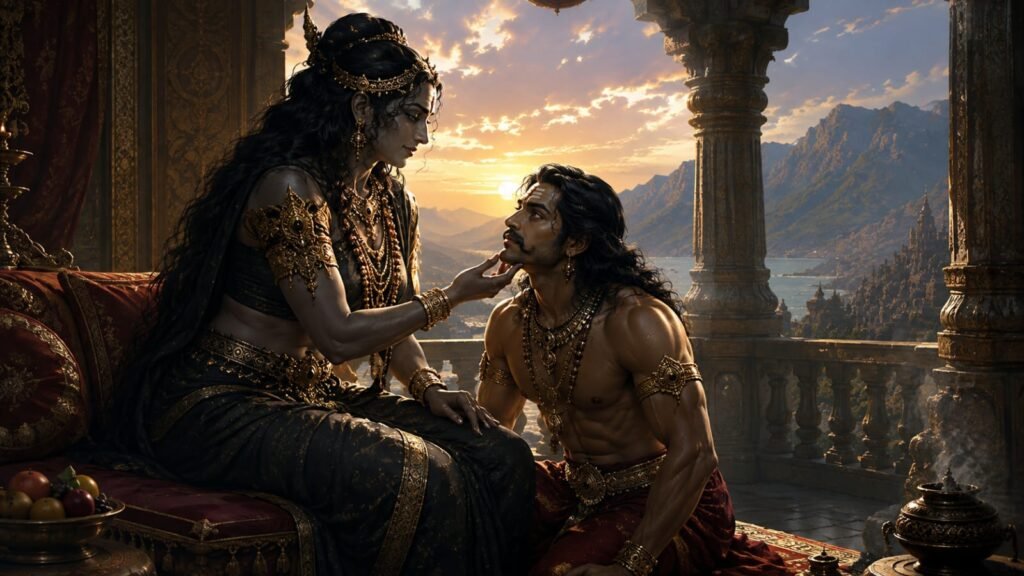
While Ravana inherited his father’s Brahmin lineage in full, his mother Kaikesi belonged to an entirely different world, the powerful Rakshasa clan. According to the Valmiki Ramayana, Kaikesi was the daughter of the Rakshasa chief Sumali, who wanted his own descendants to eventually reclaim the lost glory of Lanka after it had been taken by Kubera. Believing that a union with the wise sage Vishrava would produce exceptionally powerful children capable of fulfilling that ambition, Kaikesi approached him directly and, in time, became his wife.
From this particular union were born four children, Ravana, Kumbhakarna, Vibhishana, and Surpanakha. Although all four shared the exact same parents, the scriptures are careful to portray each sibling with a genuinely different nature and path in life. Vibhishana followed the path of righteousness closely and eventually joined Rama’s side entirely, while Ravana instead embraced ambition, conquest, and the wider traditions of the Rakshasa kingdom his mother’s family had once ruled.
Because his mother came from this Rakshasa lineage, and because he later went on to rule the Rakshasa kingdom of Lanka himself, Ravana became known throughout the Ramayana specifically as the Rakshasa king rather than simply as a learned Brahmin’s son. His identity therefore reflected both halves of his heritage at once, his Brahmin ancestry through Vishrava and his Rakshasa heritage through Kaikesi, making him one of the most genuinely complex characters found anywhere in Hindu mythology.
Why Was Ravana Still Called a Rakshasa?
Although Ravana was born to the Brahmin sage Vishrava, the Ramayana consistently and deliberately refers to him as the King of the Rakshasas rather than emphasizing his priestly ancestry. This was because he inherited not only his father’s considerable wisdom, but also his mother’s Rakshasa heritage in equal measure. After defeating his half-brother Kubera in battle, Ravana seized the golden kingdom of Lanka for himself and established his rule as the head of the Rakshasa race from that point forward. From that moment onward, his identity became closely and permanently associated with the Rakshasa kingdom and its people, regardless of his paternal lineage.
Beyond ancestry alone, Ravana’s own actions also played a major role in shaping how he came to be remembered. Despite being a brilliant scholar and a genuine devotee of Lord Shiva, he allowed pride, anger, and an unchecked desire for power to gradually dominate his life. His repeated conquest of neighboring kingdoms, his oppression of sages who stood in his way, and his abduction of Goddess Sita are all presented in the Valmiki Ramayana as actions reflecting the qualities traditionally associated with an arrogant Rakshasa ruler, rather than the conduct expected of a righteous Brahmin scholar.
For this reason, Hindu scriptures describe Ravana as both a Brahmin by birth and a Rakshasa by identity, rule, and conduct simultaneously, without treating this as any kind of contradiction. His life demonstrates plainly that a person’s lasting reputation is shaped not only by family lineage, but just as much by the choices they make and the values they ultimately choose to uphold or abandon.
Did Being a Brahmin Prevent Ravana from Doing Wrong?
One of the most important lessons drawn from Ravana’s story is that knowledge alone never guarantees righteousness on its own. Ravana possessed extraordinary wisdom by any measure, having mastered the Vedas, understood sacred rituals in depth, and excelled as both a gifted musician and a skilled astrologer. Yet despite all of this learning, he repeatedly allowed his ambition and his ego to override the basic principles of dharma whenever the two came into conflict.
The Ramayana shows Ravana being advised, more than once, to abandon his path of conflict before it was too late. His wife Mandodari, his brother Vibhishana, and even several of his own trusted ministers urged him directly to return Sita to Rama and avoid what they clearly saw coming as a disastrous war. However, Ravana rejected every single opportunity for peace that was offered to him, convinced instead that his own strength and the divine boons he had earned made him effectively invincible against any opponent.
Through Ravana’s example, the scriptures emphasize that true greatness depends on character just as much as it depends on knowledge, if not more so. A person may possess immense learning and genuine spiritual understanding, yet if they fail to control pride, anger, and desire when it matters most, those same qualities can ultimately lead directly to their own downfall. Ravana’s fate stands as a powerful and lasting reminder that wisdom, wherever it is found, must always be guided by humility and a genuine respect for righteousness.
What Does Ravana’s Story Teach?
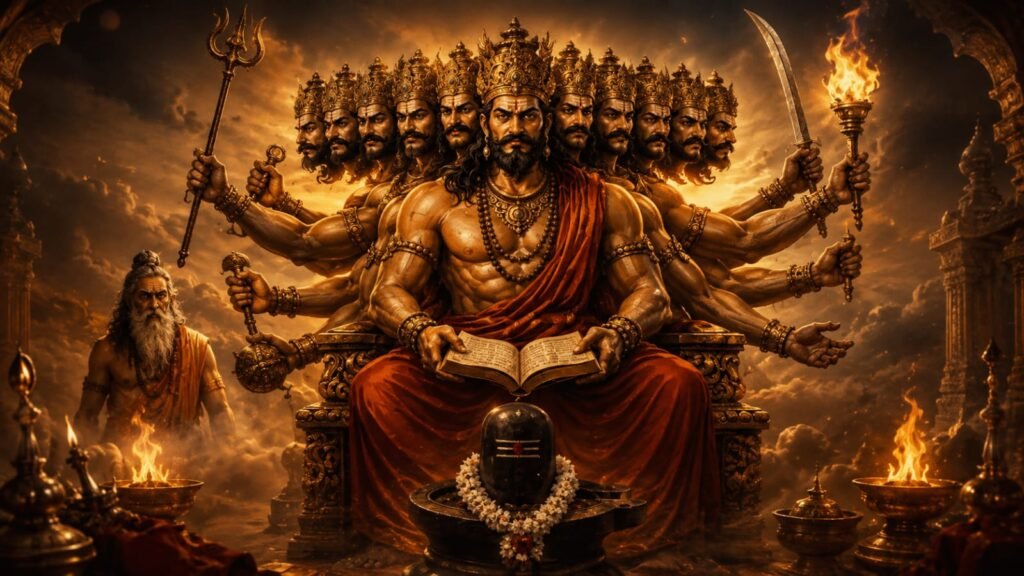
The life of Ravana remains one of the most genuinely complex narratives found anywhere in the Ramayana, precisely because it combines extraordinary virtues with equally profound flaws within a single character. He was, by any honest account, a learned Brahmin, a fearless warrior, an accomplished ruler, and a devoted worshipper of Lord Shiva. At the same time, his arrogance and his consistent refusal to accept wise counsel from those closest to him gradually overshadowed all of these remarkable qualities, leading him steadily toward his own destruction.
Many scholars and spiritual teachers view Ravana specifically as a reminder that birth and education alone never fully define a person’s true character. Although he belonged to a deeply respected Brahmin lineage stretching back to Brahma himself, it was ultimately his actions, not his ancestry, that determined how history would go on to remember him. By repeatedly choosing ambition over righteousness whenever the two conflicted, he gradually lost hold of the very wisdom that had once made him genuinely great in the eyes of others.
For this reason, Ravana remains one of the most fascinating figures found anywhere in Hindu mythology, precisely because he refuses to fit neatly into either a simple hero or a simple villain. His story teaches, above all else, that great knowledge without humility can become genuinely dangerous, while true nobility comes from living according to dharma rather than relying on birth, power, or reputation alone to define one’s worth.
Conclusion: Why Was Ravana a Rakshasa Despite Being a Brahmin?
Ravana’s identity is far more layered than it first appears to most readers encountering his story for the first time. According to the Valmiki Ramayana and the Puranas, he was born to the Brahmin sage Vishrava, making him part of a distinguished Brahmin lineage descended directly from Sage Pulastya. At the same time, his mother Kaikesi belonged firmly to the Rakshasa clan, and Ravana later became the powerful ruler of Lanka, the kingdom of the Rakshasas, in his own right. This dual heritage explains clearly why Hindu scriptures recognize both aspects of his identity at once, rather than treating them as contradictory claims that somehow cancel each other out.
The Ramayana also draws an important distinction throughout between birth and conduct, one that runs beneath the entire story. Ravana’s mastery of the Vedas, his devotion to Lord Shiva, and his extraordinary intelligence earned him genuine respect as a learned scholar in his own time. However, his pride, his desire for power, and his repeated refusal to follow dharma when it mattered most ultimately overshadowed these very real virtues. The scriptures therefore remember him not only for his knowledge, but just as much for the choices that eventually led to his downfall.
Ultimately, Ravana’s story teaches that true greatness is measured by one’s actions, not merely by birth or by learning alone. His life serves as a lasting reminder that wisdom without humility can become genuinely destructive, while righteousness, self-control, and a real respect for dharma are the qualities that actually define genuine nobility. This particular balance of brilliance and arrogance, held together in a single figure, is what makes Ravana one of the most fascinating and enduring characters found anywhere in Hindu mythology.
Frequently Asked Questions
Was Ravana really a Brahmin?
Yes. According to the Valmiki Ramayana, Ravana’s father was Sage Vishrava, a respected Brahmin and the son of Sage Pulastya, one of the Saptarishis. Through his father’s lineage, Ravana was born into a distinguished Brahmin family.
Why was Ravana called a Rakshasa?
Ravana was called a Rakshasa because his mother Kaikesi belonged to the Rakshasa clan, and he later became the ruler of Lanka, the kingdom of the Rakshasas. His identity was shaped by both his maternal heritage and his role as their king.
Was Ravana both a Brahmin and a Rakshasa?
Yes. Hindu scriptures describe Ravana as a Brahmin by paternal lineage and a Rakshasa by maternal heritage, kingdom, and identity. These two aspects of his background are not treated as contradictory within the tradition.
Did Ravana know the Vedas?
Yes. The Ramayana and later Hindu texts describe Ravana as a highly learned scholar who mastered the Vedas, understood sacred rituals, and excelled in astrology, music, and statecraft.
If Ravana was a Brahmin, why did he commit adharma?
The Ramayana teaches that knowledge alone is not enough to ensure righteousness. Although Ravana possessed great wisdom, his pride, ambition, and refusal to follow dharma led him to make destructive choices that ultimately caused his downfall.
Who were Ravana’s parents?
Ravana’s father was Sage Vishrava, a Brahmin sage, and his mother was Kaikesi, a princess of the Rakshasa clan and the daughter of the Rakshasa chief Sumali.
Was Vibhishana also born into the same family?
Yes. Vibhishana, Kumbhakarna, and Surpanakha were Ravana’s siblings, born to the same parents. However, each chose a different path, with Vibhishana remaining devoted to dharma and eventually joining Rama.
What is the main lesson from Ravana’s life?
Ravana’s story teaches that birth, knowledge, and power do not guarantee greatness on their own. The Ramayana emphasizes that a person’s true character is determined by their actions, humility, and commitment to dharma, not merely by their lineage or achievements.