
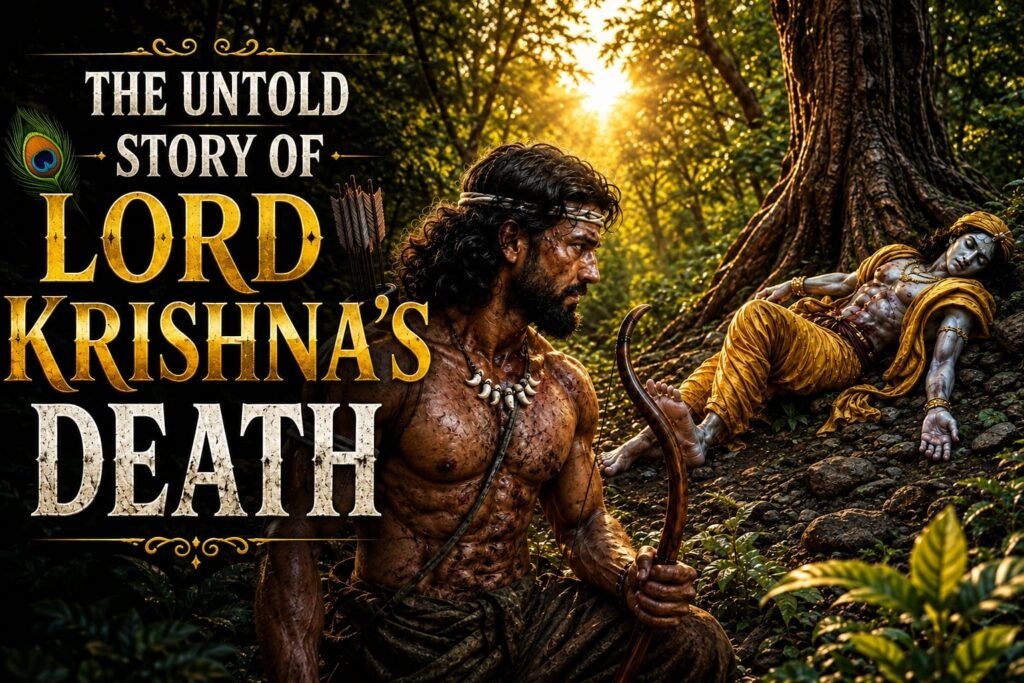
Few moments in Hindu mythology carry as much quiet weight as the death of Lord Krishna. Revered as the eighth avatar of Vishnu, the divine guide behind the Bhagavad Gita, and the strategist whose counsel shaped the outcome of the Mahabharata, Krishna is rarely remembered for how his own life came to an end. So when readers first learn that the scriptures describe him being struck by an ordinary hunter’s arrow in a quiet forest, the image can feel jarring, almost too small for a figure of his stature.
The fuller account, however, is far more layered than a single arrow suggests. The Mahabharata and the Bhagavata Purana frame Krishna’s departure as the deliberate closing chapter of a mission that had already been fulfilled, not an accident that caught him off guard. By the time the arrow was loosed, the Kurukshetra war had long restored dharma, the Yadava clan he had protected for decades had already destroyed itself through an old curse, and Krishna himself had chosen solitude over any attempt to prevent what was coming. Understanding the untold story of his death means following that fuller chain of events, from a grieving mother’s curse to a careless prank, and finally to a hunter who never meant to cause harm.
The World After the Mahabharata War
The victory of the Pandavas at Kurukshetra restored justice to the throne of Hastinapura, but it did not undo the grief left behind by the war. According to the Mahabharata, the battlefield was left covered with the bodies of countless warriors, and among those left mourning was Queen Gandhari, who had watched all one hundred of her sons fall in the conflict. When Krishna visited her afterward, she is described as confronting him directly, asking why someone with his wisdom and influence over both sides had allowed the destruction to unfold when he could, in her eyes, have prevented it.
The epic does not frame this exchange as a challenge to Krishna’s divinity, but as the raw grief of a mother who had lost everything she had. Krishna is described listening to her without defending himself or attempting to soften her pain, an unusually passive response for a figure so often shown acting decisively in the lives of others. This restraint matters, because Gandhari’s grief soon turned into words that would shape the final chapter of Krishna’s own life.
Gandhari’s Curse and the Fate of the Yadavas
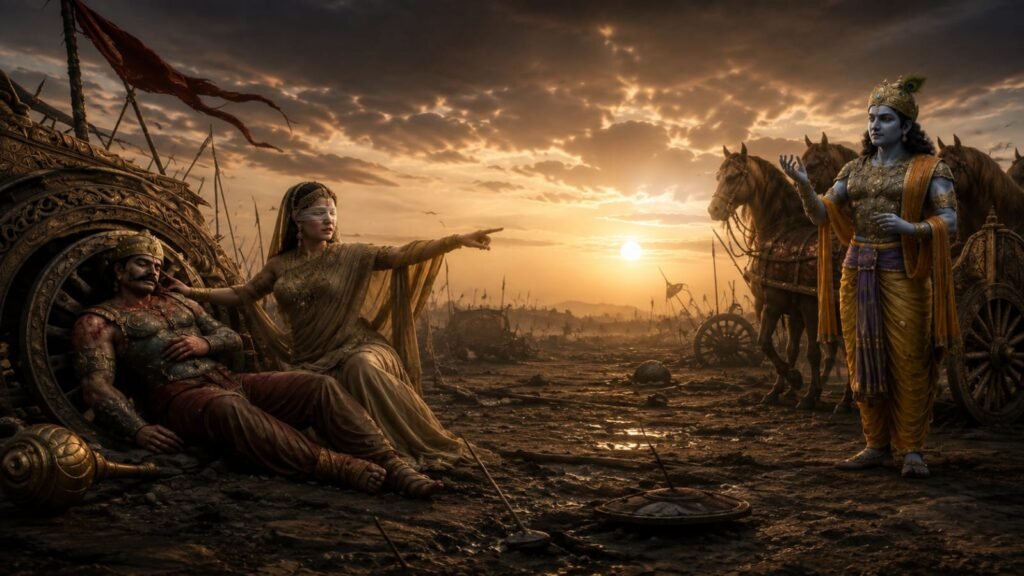
According to the Stri Parva of the Mahabharata, Gandhari declared in her sorrow that just as she had watched the Kuru dynasty destroy itself before Krishna’s eyes, his own Yadava clan would one day meet the same end, perishing through conflict from within after thirty six years had passed. This curse is sometimes read as an act of anger aimed personally at Krishna, but the epic presents it in more complicated terms, as the anguish of a woman who was not questioning his divinity so much as expressing what felt like an unbearable loss.
What stands out most in this episode is Krishna’s response. Rather than attempting to have the curse withdrawn or using his influence to shield his own family from its consequences, he is described accepting Gandhari’s words calmly, recognizing that what she foresaw aligned with a larger pattern of destiny already at work. Many scholars believe this acceptance reflects one of the clearest themes running through the final years of his life, that his purpose as an avatar was never meant to build a permanent earthly dynasty, but to restore balance for a defined period before allowing the natural order of time to continue. For decades after the curse was spoken, nothing seemed to change, and the Yadavas continued to prosper in Dwarka as though Gandhari’s words had faded into memory rather than destiny.
The Prosperity of Dwarka Before the Fall
Following the defeat of Kansa and years of conflict with the invading king Jarasandha, Krishna had established Dwarka as a fortified coastal city, and the Puranas describe it as a place of remarkable prosperity, filled with palaces, thriving trade, and some of the most capable warriors of the age. Under his protection, the Yadavas grew into one of the most powerful and respected clans in the region, and for a long stretch of years, their dominance went largely unchallenged.
This same prosperity, however, gradually gave way to something less admirable. According to the Mahabharata and the Bhagavata Purana, the younger generation of Yadava princes grew increasingly proud and overconfident as the years passed, secure in the belief that Krishna’s protection made them untouchable. What looked from the outside like an unshakable kingdom was, according to these texts, already drifting toward the very fate Gandhari had spoken of decades earlier, waiting only for the right spark to set it fully in motion.
The Prank That Changed the Fate of the Yadavas
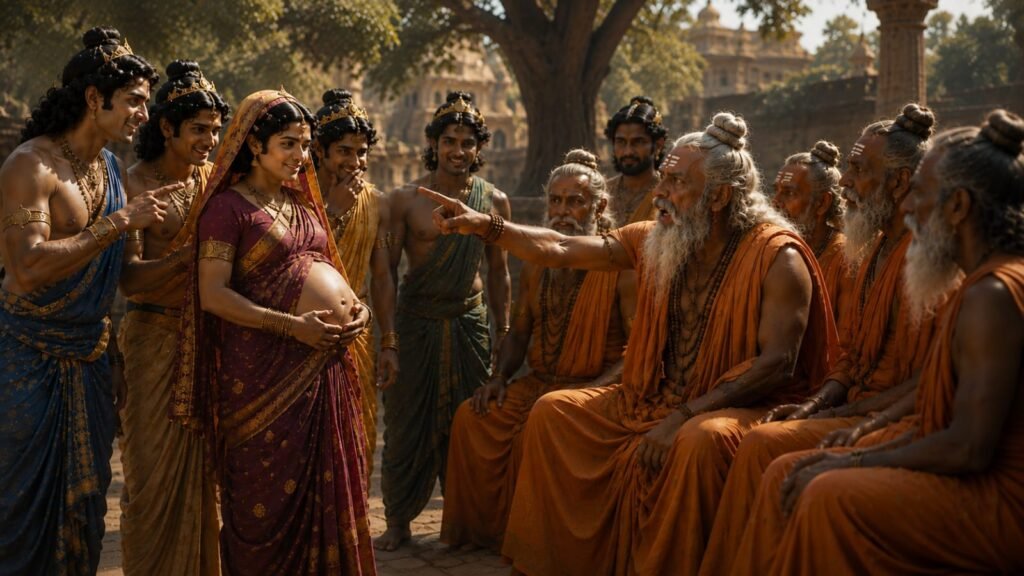
That spark came through an episode involving Samba, one of Krishna’s own sons. According to the Mausala Parva and the Bhagavata Purana, Samba and a group of young Yadava princes decided to mock a party of visiting sages who had arrived near Dwarka, disguising Samba as a pregnant woman by concealing an iron object beneath his clothing. Approaching the sages with laughter, they asked whether the woman before them would give birth to a son or a daughter, treating the respected visitors as the target of an idle joke.
The sages saw through the deception immediately, and rather than treating it as harmless mischief, they responded with a curse born from genuine offense at the disrespect shown toward them. They declared that instead of a child, Samba would produce an iron mace, and that this very weapon would become the cause of the Yadava clan’s total destruction. What had begun as a moment of careless entertainment among privileged young men had, within moments, become a prophecy threatening the future of their entire family. This episode is often cited in devotional retellings as a reminder of a recurring theme in Hindu tradition, that arrogance and the misuse of privilege tend to invite consequences that even the most powerful families cannot escape.
The Curse of the Iron Mace
The following day, according to the Mahabharata, Samba was found to have produced a solid iron mace exactly as the sages had foretold, and news of the event spread quickly through Dwarka, confirming that the curse was no idle threat. Alarmed, King Ugrasena ordered the weapon destroyed at once, and it was ground into fine powder and cast into the sea, along with the one small fragment that had resisted destruction, in the hope that scattering it would prevent the prophecy from ever coming true.
For a time, it appeared the danger had passed. Yet the scriptures describe how destiny continued working quietly beneath the surface. The powdered iron washed ashore and mixed into the sand, giving rise over time to a dense growth of reeds known as eraka grass along the coastline near Prabhasa, while the one remaining fragment was swallowed by a fish, later caught and recovered by a fisherman who fashioned it into the metal tip of an arrow. Neither the reeds nor the arrowhead seemed connected to anything significant at the time, yet both would return at the center of the events still to come, illustrating a theme found often in Hindu philosophy, that a destiny already set into motion is rarely undone by good intentions alone.
Why Krishna Did Not Prevent the Curse
A question naturally follows from all of this. If Krishna held the power to defeat tyrants and shape the outcome of a war as vast as Kurukshetra, why did he not simply prevent the curse from destroying his own family. The scriptures do not present him as powerless in this moment, since his life up to that point had shown him repeatedly protecting the righteous and altering the course of events whenever dharma required it. His restraint here, then, appears deliberate rather than forced.
According to the Bhagavata Purana, Krishna understood that the central purpose of his incarnation had already been fulfilled by this point. The tyrants who had burdened the earth had been defeated, the Kurukshetra war had restored justice, and the teachings later compiled as the Bhagavad Gita had already been delivered. The Yadava clan, whose extraordinary strength had once served that same divine purpose, had, according to this interpretation, become too powerful to remain indefinitely as the age itself began shifting from Dvapara Yuga toward Kali Yuga. Rather than resisting this transition, Krishna is described allowing it to unfold, a choice that mirrors one of the central teachings of the Gita itself, that all things, including great kingdoms, exist within a larger rhythm of creation and dissolution that no amount of personal power can hold back indefinitely.
The Gathering at Prabhasa
Sensing that the end of the Yadava dynasty had drawn near, Krishna led the clan on a pilgrimage to Prabhasa, a sacred site along the western coast traditionally associated with prayer and purification. The journey began peacefully enough, in keeping with its intended purpose, but according to the Mahabharata, the calm did not last long once the group settled at the site.
Large quantities of an intoxicating drink were consumed during the gathering, and old rivalries and wounded pride that had simmered quietly for years began resurfacing in the open. Arguments escalated quickly into violence, and in the chaos, members of the clan reached for the very reeds growing along the shore, the same eraka grass that had sprouted from the powdered remains of the cursed iron mace years earlier. The moment they were grasped in anger, the reeds are described transforming into hard iron weapons, fulfilling the sages’ prophecy with an almost mechanical precision. Friends turned against friends and brothers against brothers, and within a short span of time, nearly the entire Yadava clan had destroyed itself from within, a tragedy the Mahabharata presents not as the result of any outside invasion, but as a fate born entirely from pride that had been allowed to grow unchecked for too long.
Balarama’s Departure from the Earth
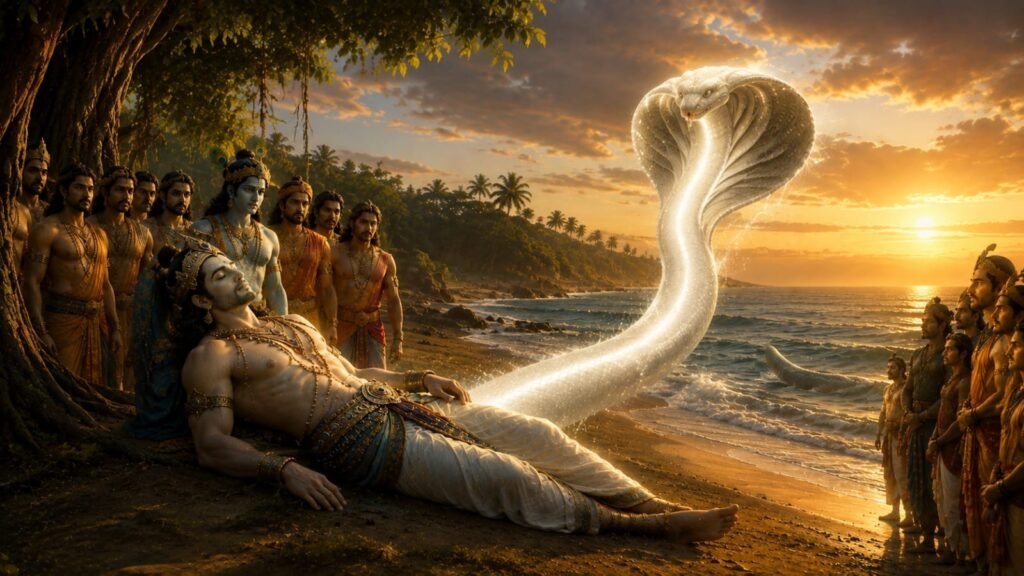
After witnessing the destruction of his clan, Krishna understood that his own earthly mission was drawing to its close as well. According to the Mausala Parva and the Bhagavata Purana, his elder brother Balarama withdrew quietly from the devastation first, seating himself in deep meditation along the seashore. As he remained absorbed in that stillness, a great serpent is described emerging from his body and returning to the ocean, identified in Hindu tradition as Ananta Shesha, the cosmic serpent upon whom Vishnu is often shown resting, confirming Balarama’s own identity as part of that same divine presence.
This departure is often read by scholars and devotees alike as a fitting close to a life that had always carried hints of this deeper identity beneath the surface. Balarama’s immense strength, his fondness for solitude even amid the bustle of Dwarka, and his occasional distance from the political affairs that consumed the rest of the Yadava clan are frequently pointed to in retrospect as quiet signs of the serpent nature waiting to reveal itself at the appointed moment. Unlike the chaos and bloodshed that had consumed the rest of the clan only moments earlier, his passing unfolds with a stillness that stands in deliberate contrast to everything happening around him.
With his brother’s departure, Krishna was left as the last remaining central figure of the Yadava dynasty, fully aware that the final chapter of his own incarnation had arrived.
Krishna’s Final Meditation in the Forest
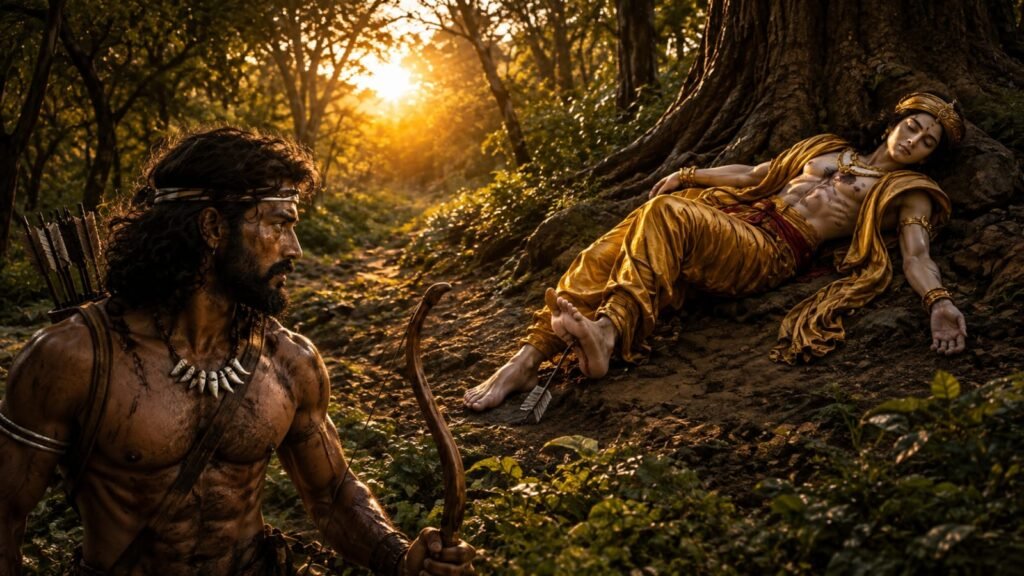
With his brother gone and the Yadava clan destroyed, Krishna chose not to return to the ruins of Dwarka or seek out whatever family members remained. Instead, according to the Bhagavata Purana, he walked alone into a quiet forest near Prabhasa, accepting that his divine work on earth had been completed. Unlike many kings who spend their final days protecting a kingdom or securing a successor, Krishna sought only solitude and inner peace.
He is described sitting beneath a tree in deep meditation, his mind entirely undisturbed, reflecting the same detachment he had spent his life teaching others to cultivate. Having restored dharma, guided the Pandavas, and delivered his teachings to the world, he is described simply waiting for his final moment to arrive, without fear and without any attempt to delay it.
There is a quiet symmetry in this choice that many devotional retellings return to again and again. Krishna’s earliest years had been spent among the forests and pastures of Vrindavan, far removed from palaces and thrones, and his final hours were spent in much the same setting, alone beneath the open sky rather than surrounded by the trappings of the kingdom he had built. This return to simplicity at the very end of his life is often read as a gentle reminder that his true nature had never been defined by wealth or rulership, but by the same stillness and presence he now carried into his last meditation.
The Hunter Jara and the Arrow
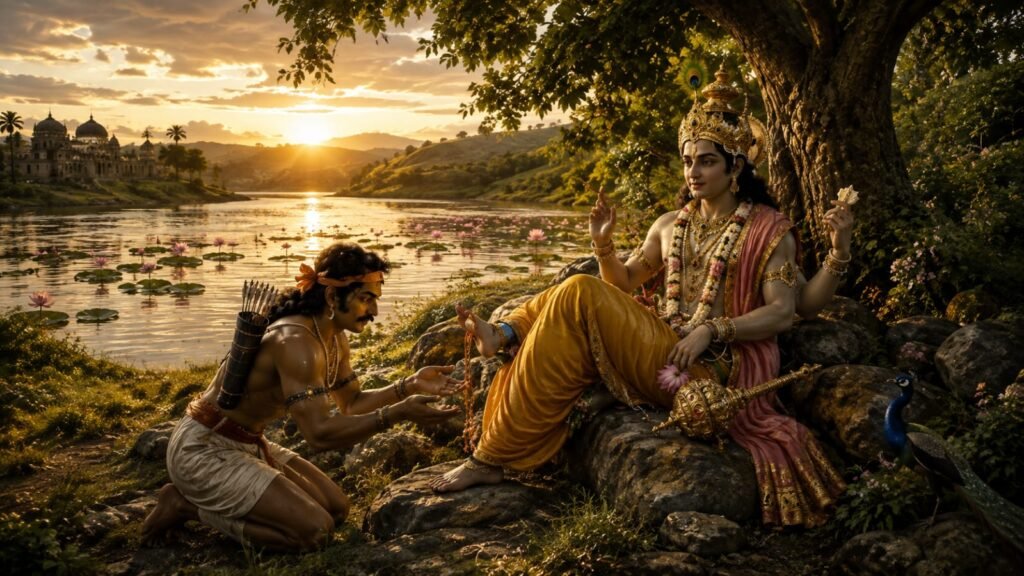
While Krishna sat in meditation, a hunter named Jara was searching the surrounding forest for deer. From a distance, he mistook the reddish, partially visible sole of Krishna’s foot for the ear of a resting animal, and released an arrow tipped with the same iron fragment that had once been swallowed by a fish and recovered from the sea.
The arrow struck its mark, and only as Jara approached to retrieve his catch did he realize, in horror, that he had wounded not a deer but Krishna himself, falling immediately at his feet to beg forgiveness for a mistake he could never have intended.
Jara’s shock in that moment is described as complete, since nothing in his life as a hunter could have prepared him for the discovery that his arrow had struck the very being worshipped across the land as the Supreme Lord. His hands are said to have trembled as he knelt beside Krishna, unable to reconcile the ordinary act of hunting he had set out to perform with the extraordinary consequence it had produced, a fear that reflects how completely unaware he had been of the identity of the figure resting beneath that tree.
Krishna’s Final Words to Jara
According to the Bhagavata Purana, Krishna responded with the same calm he had carried throughout his life, telling Jara that no sin rested on him, since everything had unfolded precisely according to a plan far larger than either of them. He explained that the hunter had merely become the instrument through which his earthly mission would reach its natural conclusion.
Some later devotional traditions go further, identifying Jara as the reincarnation of Vali, the monkey king killed from concealment by Rama in an earlier avatar, reading Krishna’s death as a kind of karmic mirror to that earlier act. This connection, while widely repeated in popular retelling, is not explicitly stated in either the Mahabharata or the Bhagavata Purana, and is best understood as a later devotional interpretation rather than a detail drawn directly from the primary scriptures themselves.
What remains consistent across every version of this exchange is the tone Krishna is said to have used with Jara, one of reassurance rather than judgment. Even in his final moments, wounded and facing the end of his time on earth, he is described choosing to comfort a frightened stranger before attending to himself, a small but telling detail that many devotees point to as proof that his compassion never wavered, not even in the instant of his own departure.
Krishna’s Return to Vaikuntha
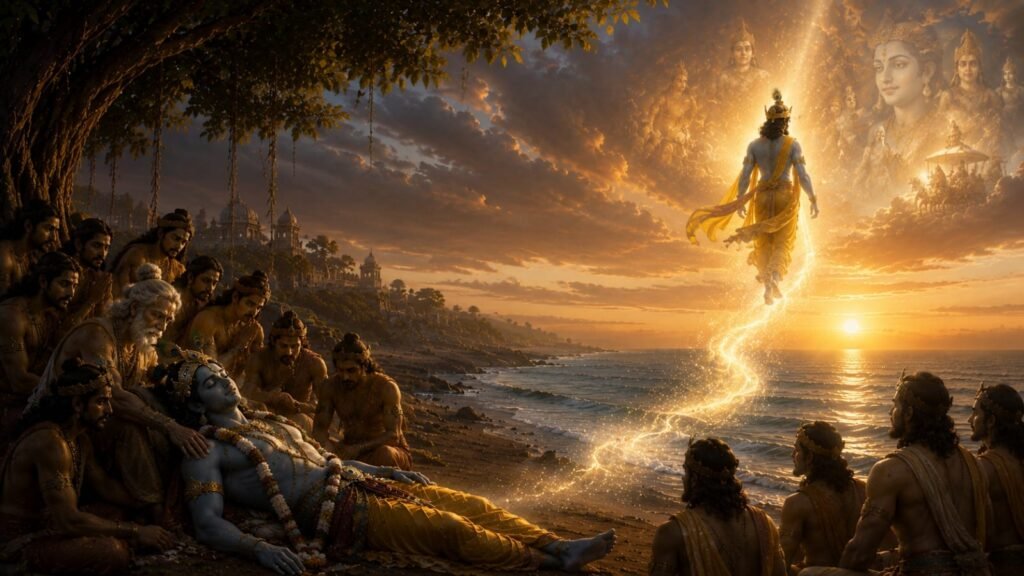
After comforting the hunter Jara, Krishna is described consciously releasing his mortal form, an event the Bhagavata Purana presents as being witnessed by celestial beings, sages, and gods gathered to mark the completion of his mission on earth. Unlike an ordinary death, this departure is framed as the deliberate conclusion of an avatar who had fulfilled every purpose for which he had descended.
According to tradition, Krishna then returned to Vaikuntha, the eternal abode of Vishnu, marking not the end of his existence but the end of this particular earthly incarnation. Hindu philosophy holds that while avatars appear and disappear according to the needs of the world at a given time, the Supreme Being beyond them remains eternal, untouched by birth or death in the way mortal beings experience it.
This return is often described in devotional literature not as a departure filled with sorrow, but as a homecoming long awaited, the natural conclusion of a journey that had begun the moment Krishna chose to descend into the world of Dvapara Yuga. For devotees, this framing transforms what could easily be read as a tragic ending into something closer to a quiet fulfillment, the closing of a circle rather than the breaking of one.
Was Lord Krishna Really Killed?
One of the most common misunderstandings surrounding this story is the idea that the hunter Jara killed Lord Krishna in any conventional sense. According to Hindu scriptures, this is not how the event is meant to be understood. The arrow fired by Jara functioned as the final occasion through which Krishna chose to conclude his earthly pastimes, not as an act that overpowered or defeated him against his will.
The Bhagavad Gita teaches that the soul can neither be born nor destroyed, a principle that applies with even greater force to the Supreme Being himself. Krishna is described accepting the arrow willingly because his mission had already reached its completion, making his departure an act of divine will rather than a defeat brought about by human action. In this reading, Jara becomes an instrument of destiny rather than someone who triumphed over God.
This distinction matters a great deal in how devotees are encouraged to understand the story, since reading it as a defeat would sit uneasily alongside everything Krishna represents throughout the rest of his life. By framing the arrow as the occasion rather than the cause of his departure, Hindu tradition preserves the idea that Krishna remained entirely in control of his own fate, even in the one moment where, on the surface, it might have looked otherwise to an outside observer.
The Spiritual Meaning of Krishna’s Departure
Krishna’s final moments carry a lesson that extends well beyond the specific details of the story. Throughout his life, he taught that everything within the material world, including kingdoms, wealth, power, and even the greatest dynasties, is temporary. The destruction of the Yadavas and his own departure put that same teaching into practice, reminding readers that nothing bound by time is built to last forever.
His story also demonstrates a complete detachment from worldly success. After restoring dharma, guiding the Pandavas, and protecting countless devotees throughout his life, Krishna quietly left the world without seeking personal glory or attempting to establish a lasting earthly empire in his own name. Instead, his final chapter suggests that the highest purpose of a life lies in fulfilling one’s duty with wisdom and righteousness, and then letting go of it without attachment once that purpose has been served.
For readers encountering this story today, the deeper takeaway rarely lies in the mechanics of the arrow or the exact sequence of curses that led to it, but in the example Krishna sets for how to meet an ending. He neither resisted what was coming nor demanded that the world remember him through a lasting throne or dynasty, choosing instead to walk quietly into a forest and let his life’s purpose speak for itself. That final image, of stillness accepted rather than power clung to, is often what devotees carry away from the story long after the details of curses and prophecies have faded from memory.
Frequently Asked Questions
Who killed Lord Krishna?
According to the Mahabharata and the Bhagavata Purana, the hunter Jara accidentally shot Krishna with an arrow after mistaking his foot for a deer. The scriptures describe Jara as the instrument through which Krishna’s earthly mission reached its conclusion, rather than as someone who defeated him.
Why did Krishna not stop the arrow?
Krishna had already fulfilled the purpose of his incarnation by this point. Rather than preventing the event, he accepted it as part of the divine plan and the natural completion of his time as an avatar on earth.
Why was Krishna’s foot struck?
The scriptures state that Jara mistook Krishna’s partially visible foot for a deer while hunting from a distance. The arrow’s iron tip had been made from the final fragment of the cursed iron mace connected to Samba’s curse.
Did Krishna forgive the hunter Jara?
Yes. According to the Bhagavata Purana, Krishna comforted Jara and assured him that he had committed no sin, since the event had occurred entirely according to divine destiny rather than through any fault of his own.
What happened after Krishna left the earth?
After Krishna’s departure, the sea gradually submerged Dwarka, an event closely associated in Hindu tradition with the end of the Dvapara Yuga and the beginning of the current age, Kali Yuga.
Is Krishna’s death mentioned in the Mahabharata?
Yes. The account appears primarily in the Mausala Parva, book sixteen of the Mahabharata, and is described in greater spiritual detail in the Bhagavata Purana, particularly within its eleventh canto.
Did Krishna really die like an ordinary human?
No. Hindu scriptures describe Krishna’s departure as the completion of his divine incarnation rather than an ordinary human death, with Krishna returning to Vaikuntha, his eternal abode, rather than simply ending his existence.
What lesson does Krishna’s departure teach?
Krishna’s final moments teach that even the greatest kingdoms and dynasties are temporary. His life reminds readers that fulfilling one’s duty, acting without attachment, and accepting the natural order of things matter more than worldly power or permanence.
Conclusion: The Real Meaning Behind Krishna’s Departure
At first glance, the story of Lord Krishna’s death may appear surprising. How could the Supreme Being who defeated mighty warriors and guided the course of the Mahabharata leave the world through the arrow of an ordinary hunter. The answer lies in understanding that Krishna’s departure was never portrayed as a defeat. Both the Mahabharata and the Bhagavata Purana present it as the final act of a mission that had already achieved everything it was meant to achieve.
The destruction of the Yadava dynasty, Gandhari’s curse, the curse upon Samba, and the encounter with the hunter Jara were all connected parts of a larger unfolding plan. Rather than resisting destiny, Krishna accepted each event with complete awareness, demonstrating the same wisdom and detachment he had spent his life teaching through the Bhagavad Gita. More than a story about death, his final journey stands as a lesson about the temporary nature of worldly life and the enduring nature of the soul, a reminder that true greatness is measured not by how long one remains in the world, but by the righteousness and wisdom one leaves behind.